
Hyperemesis Gravidarum Is Not Morning Sickness
:Why minimizing and undertreating a serious disease harms women and their pregnancy, distorts informed consent, and violates professional responsibility

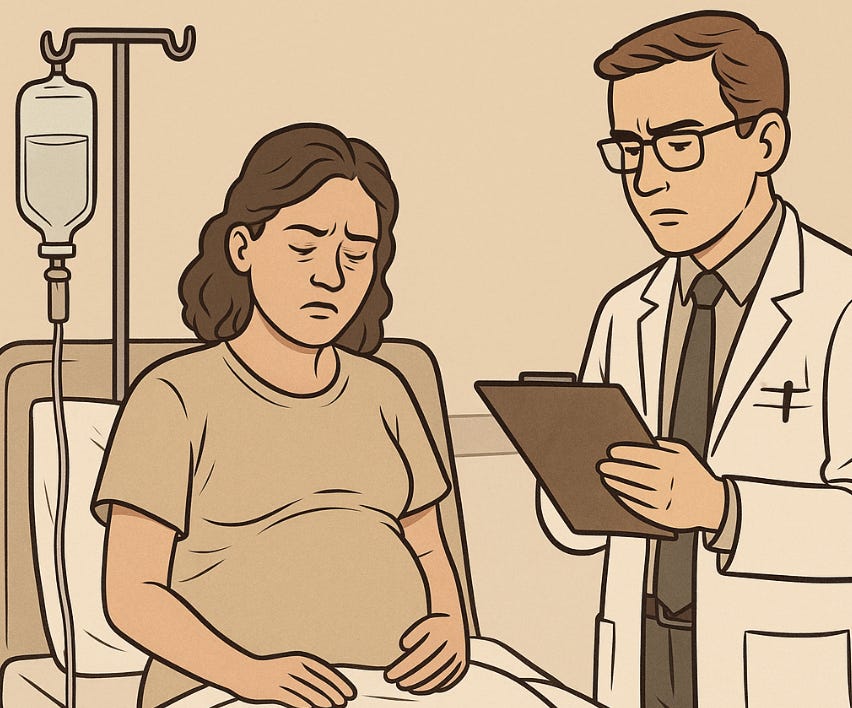
1. What Hyperemesis Gravidarum Is. And What It Is Not.
Hyperemesis gravidarum is a defined medical diagnosis. It is not a descriptive label for women who “cannot tolerate” pregnancy.
The American College of Obstetricians and Gynecologists defines hyperemesis gravidarum as the severe end of nausea and vomiting of pregnancy, characterized by persistent vomiting, dehydration, ketonuria, electrolyte abnormalities, and weight loss exceeding 5 percent of prepregnancy body weight.
ACOG explicitly distinguishes it from common nausea and vomiting of pregnancy and recognizes that it may require intravenous hydration, pharmacologic therapy, nutritional support, and hospitalization. This distinction is diagnostic, not semantic. When clinicians collapse hyperemesis into “bad morning sickness,” they are misclassifying disease, not simplifying care.
Hyperemesis gravidarum is not rare. It affects up to 1-2 of 100 pregnancies, with recurrence rates reported as high as 70 to 80 percent in subsequent pregnancies.
It is associated with dehydration, renal dysfunction, electrolyte derangements, venous thromboembolism, Wernicke encephalopathy when thiamine is delayed, malnutrition, sarcopenia, and prolonged functional disability. Psychological sequelae, including depression, anxiety, and post-traumatic stress symptoms, are common. Most importantly, hyperemesis gravidarum is repeatedly cited in the peer-reviewed literature as a leading medical reason for termination of otherwise wanted pregnancies. That fact alone should recalibrate how seriously we treat it.
2. What Women Experience When Medicine Minimizes the Disease
As a maternal–fetal medicine specialist, I am often consulted late. Women arrive after reassurance has failed, after oral intake has stopped, after their lives have narrowed to surviving the next hour. One woman recently described disappearing from her professional life for nearly two months. Not for rest. For survival. Food was impossible. Water was a gamble. Standing triggered vertigo so severe that lying still did not stop the room from spinning. Vomiting occurred more than a dozen times a day. She described muscle loss from prolonged immobility and the psychological erosion that follows sustained physical torment.
She admitted something many women carry silently. At moments, she considered ending a wanted pregnancy because the suffering felt unendurable. That admission is not a moral failure. It is clinical evidence of disease severity. When hyperemesis drives women to contemplate termination, the ethical question is not about resolve or values. It is about untreated or undertreated disease.
3. What the Evidence Shows. And What It Does Not
The peer-reviewed literature is consistent on three points. First, hyperemesis gravidarum is a biologically severe disorder with hormonal, gastrointestinal, neurologic, and metabolic components. It is not psychiatric fragility and not a failure of coping. Second, delayed or fragmented treatment worsens maternal morbidity and prolongs recovery. Third, early, structured, multimodal treatment improves outcomes and reduces repeated hospitalization.
Systematic reviews and guideline-based analyses support stepwise antiemetic therapy, early intravenous hydration with electrolyte and thiamine replacement, and escalation to enteral nutrition when oral intake fails. This is not aggressive care. It is appropriate care. What is often framed as overtreatment is more accurately undertreatment.
4. Why Counseling and Treatment Still Fail Women
A major ethical failure in hyperemesis care lies in how risk is communicated. Fear-based counseling around antiemetics, particularly ondansetron, remains common. Presenting isolated potential risks without absolute risk, baseline risk, or comparison to the harms of untreated disease is not informed consent. It shifts the burden of uncertainty onto women who are already profoundly unwell.
Evidence-based treatment includes intravenous hydration with electrolyte repletion, thiamine supplementation before dextrose, and timely use of antiemetics such as doxylamine–pyridoxine, metoclopramide, ondansetron, and promethazine. Corticosteroids have a role in refractory cases. Acid suppression is appropriate when indicated. Enteral nutrition should not be treated as a last-ditch failure after months of decline. Multidisciplinary care matters, including physical therapy for deconditioning, vestibular rehabilitation when balance collapses, and mental health support not because the disease is psychiatric, but because prolonged physiologic suffering predictably harms psychological health.
5.Treatment Is Medicine. Reassurance Is Not Enough
Treatment of hyperemesis gravidarum must be active, anticipatory, and sustained. Reassurance alone is not treatment. Telling women to “try small sips” or “wait it out” once objective disease is present is clinical inertia. Evidence-based care begins with early correction of dehydration and metabolic derangement. Intravenous fluids with electrolyte repletion are foundational, not optional, and thiamine must be administered before any dextrose-containing fluids to prevent Wernicke encephalopathy. Delay here is not benign.
Pharmacologic therapy should follow a stepwise but timely approach. First-line therapy includes doxylamine–pyridoxine. When insufficient, escalation to dopamine antagonists such as metoclopramide or promethazine is appropriate. Ondansetron remains an effective and widely used option, particularly when vomiting is relentless and oral intake has failed. In refractory cases, corticosteroids may be considered with appropriate counseling. Acid suppression with H2 blockers or proton pump inhibitors is indicated when gastroesophageal irritation worsens symptoms. When oral intake cannot be maintained despite these measures, enteral nutrition should be initiated early rather than framed as a last-resort failure after weeks or months of decline.
Care must extend beyond the hospital. Home-based treatment can be transformative and is underutilized. This includes scheduled home intravenous hydration, antiemetic administration, and nursing support that allows women to remain functional and avoid repeated emergency department visits. Nutritional counseling, realistic dietary adjustments based on tolerance rather than idealized nutrition, and avoidance of guilt-driven advice are essential. Adjunctive measures such as ginger, acupressure, or vitamin supplementation may offer modest benefit for some women but should never be used to replace medical therapy when disease is severe.
Hyperemesis is a prolonged illness, not an episodic complaint. Treatment plans must acknowledge duration, recurrence risk, and the cumulative toll on physical and psychological health. The goal is not endurance. The goal is stabilization, nutrition, function, and preservation of dignity. When treatment is framed this way, hyperemesis becomes a condition we manage deliberately rather than a burden we quietly shift back onto the patient.
6. The Ethical Bottom Line
Hyperemesis gravidarum today occupies the same space endometriosis did years ago. Poorly understood. Underestimated. Surrounded by misinformation. The difference is timing. Hyperemesis unfolds early in pregnancy, often forcing women to disclose deeply personal medical information at five or six weeks simply to explain their disappearance, long before many pregnancies feel secure.
Ethics here are not abstract. Beneficence requires early and decisive treatment when suffering is severe. Nonmaleficence includes harm from inaction, not just harm from intervention. Respect for autonomy begins with believing women when they say they cannot eat, cannot walk, cannot work, and cannot endure months more of this. Justice requires acknowledging that access to home infusion services, nutritional support, and workplace flexibility is uneven, and that the burden of “pushing through” falls hardest on women with fewer resources.
Hyperemesis gravidarum does not need to kill a woman to devastate her life. Some women develop long-term psychological injury. Some terminate pregnancies they desperately wanted and never try again. These are not rare outliers. They are foreseeable outcomes of prolonged, unmanaged disease.
Believing women is not optional. It is a clinical obligation.