
How New York’s Prenatal Care System Betrays Its Ideals: The Nations of Care
New York City does not have one prenatal care system. It has at least three. They coexist in the same geography as parallel nations: the Protected, the Processed , and the Abandoned Nations.

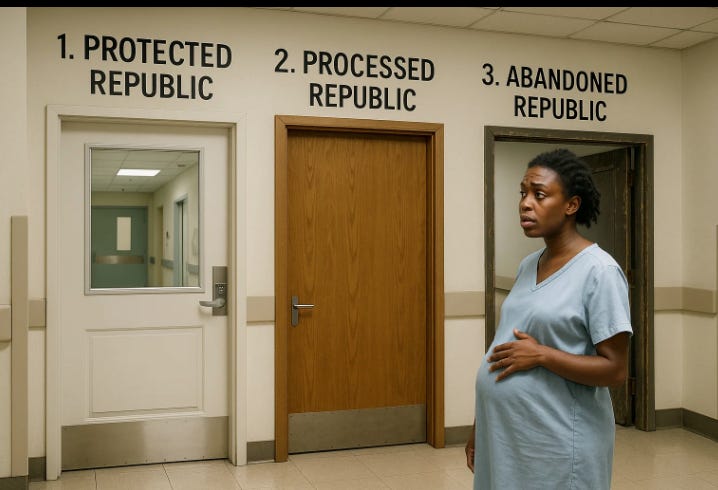
At 34 weeks pregnant, she waited six hours in a public hospital clinic before being seen. Her chart listed gestational hypertension; her blood pressure that day was 156/98. She was sent home with a follow-up in two weeks. Two miles away, another woman—also 34 weeks, also hypertensive—was seen in her doctor’s office as soon as she arrive and admitted that afternoon for evaluation, treated promptly, and delivered safely two days later.
Both were New Yorkers. Both carried the same diagnosis. But they lived in different Nations of Birth.
I know about these very well as I have worked in these NYC Republics. I worked at 3 different hospitals, each a different Republic on it’s own.
New York City does not have one prenatal care system. It has at least three. They coexist in the same geography yet function as parallel nations: the Protected Nation, the Processed Nations, and the Abandoned Nation. Their borders are drawn not by medical need but by insurance, income, and institutional privilege. The result is a hierarchy of safety that mirrors the inequities of the city itself.
In some parts of the city, the inefficiency is almost architectural. Within a few blocks, two hospitals may stand side by side, one serving privately insured patients in quiet rooms with coordinated care teams, the other overcrowded, under-resourced, and reserved for those on Medicaid or without insurance. The duplication wastes resources while institutionalizing segregation. In all my travels in Europe I have never seen an inefficient system like this. A unified maternal system could deliver better care for all, yet New York clings to parallel structures that protect privilege rather than patients.
In most of Western and Northern Europe (for example, France, Germany, the Netherlands, the U.K., Scandinavia), maternity and general hospitals are regionalized, not duplicated. There may be multiple hospitals in a city, but they are all part of a national or regional health service, and patients are assigned by geography or clinical need, not by ability to pay.
Example: In Paris or London, a pregnant patient might choose among nearby maternity units, but all are publicly funded and follow the same national safety and referral standards.
Hospitals do differ in academic focus or amenities (e.g., private rooms, birth centers), but not in basic quality or eligibility.
Private maternity hospitals exist (e.g., in the U.K., France, or Spain), but they represent a small fraction of births, not a parallel system.
2. The “Two-Speed” Problem, Not the “Two-Hospital” Problem
Europe has inequities, but they manifest differently:
In some countries, waiting times or regional staffing shortages create de facto delays, especially in rural or post-industrial areas.
In Southern and Eastern Europe (e.g., Italy, Greece, Poland), underfunding or informal “under-the-table” payments may introduce inequity, but patients still use the same hospitals.
The private sector supplements the public system, but does not duplicate it side-by-side. A single labor ward in Lisbon or Lyon serves both rich and poor; the distinction is the room you recover in, not the safety of your care.
3. Why the U.S. Model Is Unique
New York’s split-hospital landscape stems from:
Insurance segmentation — Medicaid vs. private vs. self-pay.
Hospital financing — public vs. voluntary (nonprofit) systems competing for profitable patients.
Historic racial and neighborhood segregation — many safety-net hospitals evolved from charity or municipal facilities in minority neighborhoods, while private hospitals clustered in affluent areas.
Policy inertia — closing a redundant or inequitable hospital is politically fraught, even when consolidation would improve efficiency.
The result: two hospitals, two staffing ratios, two standards of monitoring, and two patient populations within walking distance. No European capital tolerates such structural duplication.
The Protected Nation
Here, pregnancy is managed with precision and calm. Patients have direct phone access to their obstetrician, ultrasound on demand, and coordinated referrals to maternal–fetal medicine. Visits start on time. Text messages are answered. The atmosphere is one of control and assurance.
This is the domain of those with private insurance or concierge access, where continuity of care is assumed and risk is mitigated through abundance. The Protected Republic is not defined by better medicine; it is defined by more of it. Time, technology, and vigilance are not rationed here.
The Processed Nation
Most New Yorkers reside in this middle tier. Care is technically adequate, guideline compliant, standardized, and efficient, but transactional. Visits are brief, ultrasounds scheduled weeks ahead, referrals routed through prior authorizations. The obstetrician knows the system better than the patient; the patient, meanwhile, learns the choreography of waiting rooms, patient portals, and rotating call schedules.
This is medicine by template. The system works, until it doesn’t. When complications arise, care coordination falters, and a patient who should be admitted for observation may instead be told to return if symptoms worsen. Efficiency becomes a form of quiet neglect.
The Abandoned Nation
Here is where the city’s rhetoric of equity collides with its bureaucracy. Patients on Medicaid or without insurance are assigned to resident clinics, where physicians rotate monthly and staffing ratios are unsafe. Long waits, missing labs, and inconsistent follow-up are routine.
Minority women are disproportionately confined to this Republic. Structural barriers, transportation, inflexible work schedules, language, childcare, and fear of losing wages, compound the medical risks. By the time they arrive in triage, it is often too late to prevent catastrophe.
The data are not subtle. Black women in New York City are four times more likely to die of pregnancy-associated causes and six times more likely to die of pregnancy-related causes than White women. One in seven births occurs after inadequate prenatal care. Nearly a third of Black mothers in the Bronx report gaps or delays in care. These are not the residues of poverty alone; they are the predictable outputs of a tiered healthcare market that rewards those who can pay and tolerates rationing for those who cannot.
Structural Inequity Masquerading as Choice
Defenders of this structure invoke “choice.” Patients, they say, may select their provider, their hospital, their level of service.
But choice presumes options. For many women, there are none. Medicaid reimbursement rates drive private practices away; safety-net hospitals absorb the overflow.
What we call “access” is, in reality, triage disguised as policy.
Professional responsibility demands that clinicians name this for what it is: structural neglect. The notion that some women’s pregnancies deserve surveillance while others must wait until a crisis arises contradicts both medical ethics and civic integrity.
Professionalism and the Moral Economy of Care
Obstetricians are trained to manage biological risk. Yet in New York, the greater danger often lies in social and institutional design. The very system that promises universal maternal safety functions as an instrument of stratification. It sorts not only patients but priorities.
Professional duty cannot end at the bedside when the system itself creates harm. The same vigilance applied to fetal heart rate patterns should apply to patterns of inequity—unequal appointment availability, differential referral speed, and the invisibility of Medicaid patients in private hospital corridors.
This is not an attack on individual clinicians. Many in the Abandoned Republic perform heroic work with impossible caseloads. But heroism is not a substitute for justice. The moral burden rests on policymakers, hospital executives, and professional leaders who permit these inequities to persist while invoking “quality improvement” as a slogan.
The Work of Repair
Repair begins by flattening the different Nations. That means:
Expanding funding for high-volume public clinics and community obstetric services.
Ensuring Medicaid reimbursement covers full prenatal coordination, not just visits.
Embedding care navigators and doulas where barriers are greatest.
Disclosing outcomes by insurance status and race, not merely by hospital.
Reaffirming that professional responsibility extends to system design, not only patient care.
These are not radical measures; they are the minimum standard of an ethical city.
And the best solution? Instituting universal healthcare like in Europe where pregnant patients can choose which doctors they want to see. And where every single doctor‘s practice must accept every patient. Whether the office is on Park Avenue or the Bronx.
The Nation, Recsonsidered
In the Protected Nation, pregnancy is planned, personalized, and buffered from risk.
In the Processed Nation, pregnancy is managed, timed, and billed.
In the Abandoned Nation, pregnancy is endured.
A city that tolerates such moral geography cannot call itself equitable.
For all its world-class hospitals, New York remains a place where the odds of a safe birth can still depend on your insurance card and ZIP code. Until the Republics of Birth are reunited, our healthcare system will continue to reproduce the very inequality it claims to heal.