
High-Risk Pregnancy: What It Actually Means and Why Knowing the Details Matters More Than the Label
You were told your pregnancy is “high risk.” That tells you almost nothing. Here is what you actually need to know.


A 38-year-old woman sits in her obstetrician’s office. She is 10 weeks pregnant. Her doctor tells her this is a “high-risk pregnancy” because of her age, her BMI of 34, and the fact that her first baby was delivered by cesarean at 36 weeks for preeclampsia.
She leaves the office anxious but unclear. High risk for what, exactly? Is her baby going to be too big or too small? Should she be worried about her blood pressure or her blood sugar? Will she need to deliver early again? What tests should she expect and when? Nobody said.
This is the fundamental problem with the term “high risk.” It is a category, not a diagnosis. It tells a woman she should be concerned without telling her what to be concerned about. And different conditions create entirely different risks that require entirely different monitoring, different interventions, and different delivery plans.
If your pregnancy is labeled high risk, you deserve more than a label. You deserve specifics.
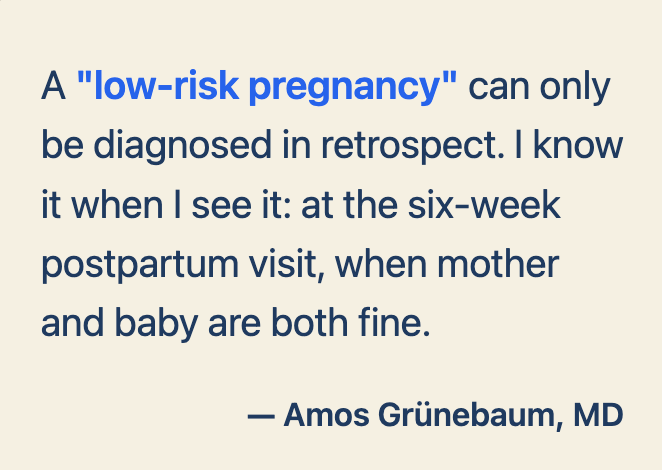
What “High Risk” Actually Means
A high-risk pregnancy is any pregnancy in which the mother, the baby, or both face an increased chance of complications compared to an uncomplicated pregnancy. Roughly 6-8% of pregnancies involve high-risk complications [1], though some estimates are higher depending on how broadly the term is defined. A 2025 meta-analysis found that about 12% of pregnancies involve multiple high-risk factors [2].
High-risk conditions fall into two categories:
Conditions identified before pregnancy or early in pregnancy. These include your medical history, your obstetric history, and your demographics. They are known risks walking in the door. Examples: chronic hypertension, pre-existing diabetes, advanced maternal age, prior cesarean delivery, prior preterm birth, prior stillbirth, obesity, autoimmune disease.
Conditions that develop during pregnancy. These emerge as the pregnancy progresses and are detected through routine screening and surveillance. Examples: gestational diabetes, preeclampsia, placenta previa, fetal growth restriction, preterm labor, cervical insufficiency.
Some women have both. The 38-year-old in our opening scenario has pre-existing risk factors (age, obesity, prior preeclampsia) that also increase her chance of developing new complications during this pregnancy.
