
Good Eggs, Bad Eggs: What Prospective Parents Need to Know
Your chances getting pregnant depends a lot on your eggs, quantity and quality

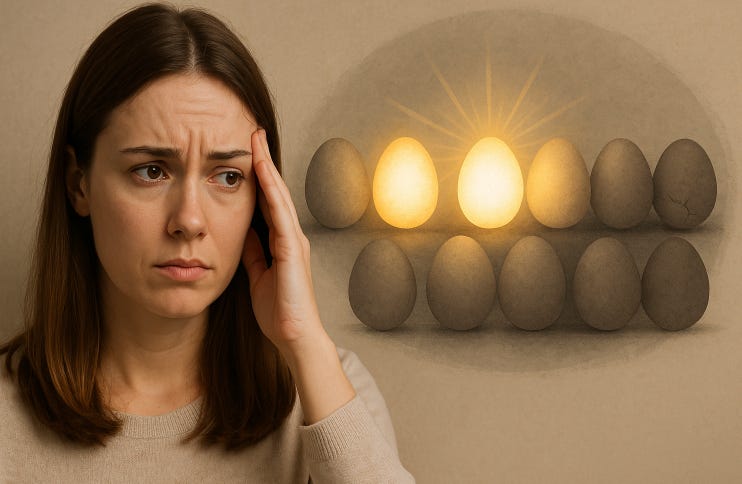
When Sarah came to see me at age 34, she was healthy, active, and eager to start a family. She had regular cycles, no medical issues, and assumed getting pregnant would be easy. What she didn’t know—and what so many women and couples don’t realize—is that the quality of a woman’s eggs is the single most important factor in fertility.
Fertility and the Role of Eggs
Every woman is born with all the eggs she will ever have. Unlike sperm, which are produced daily throughout a man’s life, egg supply steadily declines from birth until menopause. But it’s not only the number of eggs that matters—it’s their quality.
A “good egg” contains the right number of chromosomes and healthy mitochondria (the energy factories inside cells). This makes it much more likely to fertilize, develop into a healthy embryo, and result in a live birth. A “bad egg,” by contrast, may have chromosomal errors, damaged DNA, or weak energy reserves. These eggs either fail to fertilize, fail to implant, or result in early miscarriage.
Age and Egg Quality
Age is the most powerful influence on egg quality. At age 20, about 80–90% of a woman’s eggs are chromosomally normal. By age 35, that percentage drops to about 50%. By 40, only about 10–20% of eggs are normal. This explains why fertility treatments such as IVF have much higher success rates in younger women, even when using the same protocols.
This decline is a biological reality—not something you can control with diet or supplements. While healthy living helps overall fertility, it cannot turn an abnormal egg into a normal one.
Can We Test Egg Quality?
This is where things often get confusing for patients. Doctors can measure egg quantity—but not egg quality—with current tests. Blood work such as AMH (Anti-Müllerian Hormone) or day-3 FSH, along with ultrasound antral follicle counts, are widely used in fertility clinics. They can estimate how many eggs remain, but they say little about whether those eggs are healthy.
AMH in particular has been marketed as a kind of fertility crystal ball, even sold directly to consumers. But it’s not fool-proof. A high AMH does not guarantee good eggs or pregnancy success, and a low AMH does not mean you cannot conceive. It only reflects the size of the ovarian reserve, not the genetic integrity of the eggs.
Consider two examples:
A 30-year-old with a low AMH may still have mostly chromosomally normal eggs, meaning her chance of pregnancy per egg is high.
A 42-year-old with a normal AMH may still face a high percentage of abnormal eggs simply because of age.
The critical point: egg quality is driven far more by age than by lab results. Even with all our modern technology, the only way to truly observe egg quality is indirectly—through fertilization, embryo development, and sometimes genetic testing of embryos in the IVF lab.
For prospective parents, this means two things:
Do not panic if your AMH is “low”—it does not mean zero chance.
Do not feel falsely reassured if your AMH is “normal”—it does not cancel out the effect of age.
In short, AMH is a useful tool for guiding fertility treatments, especially IVF stimulation, but it is not a fertility predictor for natural conception. Relying too heavily on the number can cause unnecessary anxiety—or false confidence.
Polycystic Ovary Syndrome (PCOS)
What it is:
Polycystic Ovary Syndrome, or PCOS, is a hormonal condition that affects about 1 in 10 women of reproductive age. It’s characterized by irregular menstrual cycles, higher levels of male-type hormones (androgens), and ovaries that often appear “polycystic” on ultrasound—meaning they contain many small, immature follicles.
How it affects eggs and fertility:
Women with PCOS typically have a large number of eggs—in fact, their AMH levels are usually higher than average. But the challenge lies in how those eggs mature and are released. Many women with PCOS do not ovulate regularly. When ovulation does occur, the egg may not be fully mature, which reduces the chance of successful fertilization.
Importantly, PCOS does not inherently damage the eggs. When a healthy, mature egg is released, its quality is generally the same as that of women without PCOS at the same age. The main barrier is irregular or absent ovulation.
What can be done:
Treatments often focus on restoring regular ovulation. This may include lifestyle changes such as weight management, medications like letrozole or clomiphene, and sometimes injectable fertility drugs. With the right approach, most women with PCOS can conceive, though it may take longer and require medical support.
Premature Ovarian Insufficiency (POI)
What it is:
Premature Ovarian Insufficiency (POI), formerly called premature ovarian failure, is a condition where the ovaries lose their normal function before age 40. It affects about 1% of women. Unlike natural menopause, which occurs on average around age 51, POI happens much earlier—sometimes in the teens, 20s, or 30s.
How it affects eggs and fertility:
Women with POI have a very low number of eggs remaining. Periods may become irregular or stop altogether. Estrogen levels often fall, leading to symptoms similar to menopause, such as hot flashes and bone loss. Fertility is usually severely reduced because so few eggs are left.
Unlike PCOS, the issue here is not too many eggs stuck in immature stages, but rather too few eggs overall. Egg quality may be normal for the woman’s age, but scarcity makes conception difficult. A small percentage of women with POI may still ovulate occasionally and conceive naturally, but this is rare.
What can be done:
Hormone replacement therapy is important for bone and heart health. For family-building, most women with POI require donor eggs if they wish to carry a pregnancy. Genetic counseling may also be helpful, since some cases are linked to inherited conditions.
Lifestyle and “Egg Health”
While age sets the baseline, lifestyle factors can make a difference. Smoking, obesity, and poorly controlled medical conditions like diabetes harm eggs. Excessive alcohol and environmental toxins may also play a role. On the flip side, maintaining a healthy weight, eating a balanced diet, exercising moderately, and taking a prenatal vitamin with folic acid support fertility overall.
Some studies suggest that antioxidants, vitamin D, or supplements like CoQ10 may help egg energy production, but evidence is limited. None of these can reverse age-related changes.
Options for Parents
Understanding egg quality helps prospective parents make realistic choices:
Younger couples trying to conceive naturally can be reassured that most eggs are good and patience is often all that’s needed.
Couples in their mid- to late-30s may want to seek evaluation sooner if pregnancy doesn’t occur within 6 months.
Women in their 40s may need to consider assisted reproduction, donor eggs, or alternative family-building options. Donor eggs, from younger women, carry dramatically higher success rates because of their better quality.
The Emotional Side
Talking about “good eggs” and “bad eggs” can feel harsh. Many patients worry it sounds like a judgment about them. It’s not. Egg quality is biology, not character. And while the concept may seem discouraging, knowledge empowers couples to plan ahead, explore options early, and avoid wasted time or unnecessary guilt.
Closing Reflection
When Sarah learned that egg quality—not just quantity—was the key factor, she and her partner made informed choices sooner rather than later. She became pregnant after two IVF cycles, and she told me later: “I wish I had known this earlier.”
The reality is simple but profound: women cannot make new eggs, and age affects egg quality more than any other factor. Should society do more to educate young people about this reality—long before they are in my office, worried about their chances?