
Franz Kafka and the Bureaucracy of Birth
How a writer of absurdity and alienation helps us understand the emotional and ethical weight of navigating maternity systems.

Understanding the Issue
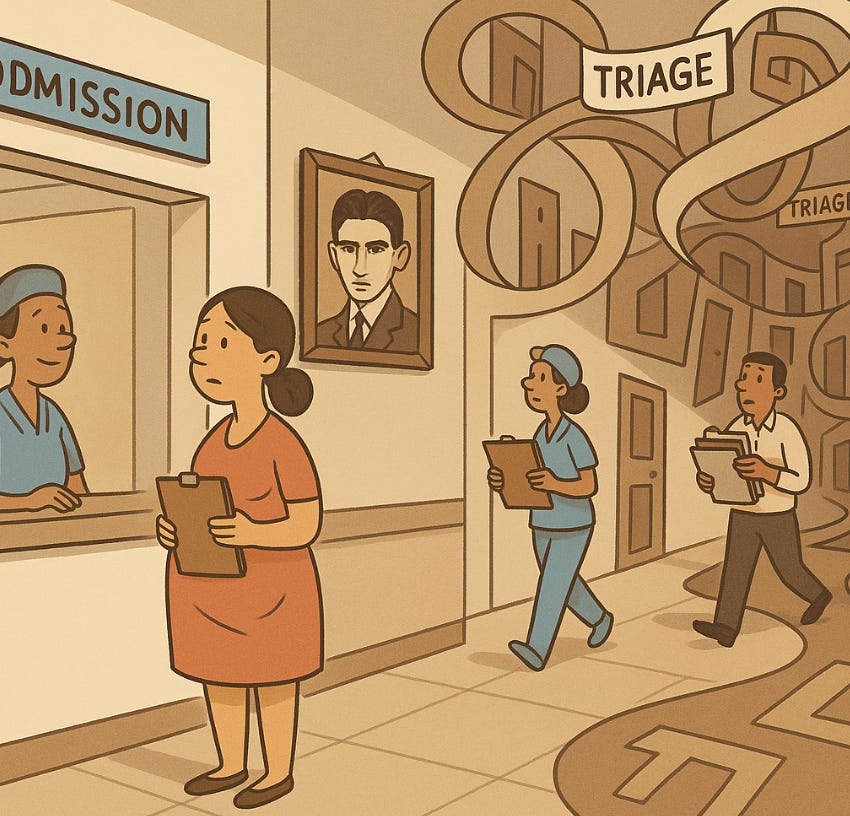
Franz Kafka (1883–1924) was a Czech-born writer who spent most of his working life in Prague as a lawyer and bureaucrat for an insurance agency. His fiction examined how ordinary people struggle within systems that feel confusing, opaque, and overwhelming. Kafka never wrote about childbirth. Yet his insights into waiting, uncertainty, surveillance, and powerlessness resonate strongly with the experiences many pregnant women face today. Obstetrics is filled with protocols, forms, monitoring, and layered decision-making. Kafka helps us see how these structures shape the emotional experience of pregnancy, not only the clinical one.
1. Pregnancy inside a system that feels larger than the patient
Kafka’s characters often stand before institutions they cannot fully understand. Many pregnant women describe something similar when entering the maternity care system. They are given schedules, ultrasounds, lab results, and risk categories that feel foreign and sometimes intimidating. Every appointment adds new information but not always new clarity. Kafka teaches us that systems become unsettling when their inner workings are not explained. Obstetric care improves when clinicians actively demystify the process, explain why each test is needed, and make sure the woman understands how choices connect to outcomes. Transparency can be a form of compassion.
2. Anxiety grows in silence and uncertainty
Kafka wrote about characters trapped in long corridors and endless waiting. Pregnancy, especially late pregnancy, contains similar stretches of uncertainty. Many women wait for test results or watch the fetal tracing shift without understanding its meaning. Uncertainty breeds anxiety, not because the patient is fragile, but because the stakes are deeply human. Clinicians sometimes underestimate the emotional cost of ambiguous information. Kafka would argue that uncertainty without guidance becomes its own burden. When clinicians name the uncertainty and explain what happens next, they give structure to the unknown. This reduces fear and strengthens trust.
3. Surveillance without explanation feels dehumanizing
Kafka’s stories often describe characters being observed without knowing why. Modern obstetrics uses continuous monitoring, vital sign tracking, and structured documentation. These tools are essential for safety, but they also create a sense of being watched. Many women describe feeling reduced to a collection of numbers. Kafka helps us see why. Surveillance is tolerable when its purpose is shared. It becomes oppressive when the meaning is hidden. Clinicians can change this experience simply by narrating what they are doing and why. When monitoring becomes a partnership rather than a silent process, the woman regains agency.
4. Bureaucracy can fracture communication when it should support it
Kafka understood that institutions can unintentionally create barriers between people. Obstetric units rely on policies, staffing structures, and documentation requirements that sometimes disrupt communication. A woman may repeat her history to multiple team members or receive conflicting messages. She may feel lost in the handoffs. Kafka would say this is not a personal failure. It is a structural problem. Obstetric care becomes safer and more humane when teams coordinate more clearly, when information flows consistently, and when every clinician assumes responsibility for closing communication gaps. Even small inconsistencies can create large emotional consequences in labor.
5. Respecting humanity within a complex system
Kafka’s work reminds us that individuals can feel small inside powerful institutions. Pregnancy magnifies this vulnerability. The woman in labor must rely on the system for safety while also trying to preserve her sense of identity. She is not only a patient. She is a full person with history, fear, strength, and agency. Obstetric care reaches its highest ethical standard when it protects that identity rather than eroding it. Clinicians cannot dismantle the complexity of the system, but they can counterbalance it with presence, explanation, and respect. Kafka’s insight is simple. Even in the most structured environments, humanity is not optional. It is the anchor.
Reflection
Kafka did not set out to teach lessons in obstetrics. Yet his writing reveals what happens when individuals face systems that are opaque or overwhelming. Pregnancy often brings women into contact with similar structures. The challenge for modern obstetrics is to make these systems intelligible, compassionate, and navigable. Kafka leaves us with a clear question. In the moments when childbirth feels like entering a maze, how can clinicians ensure that the woman never loses sight of herself.