
Forbidden Foods III: Spices and Strange Beliefs – Do Spicy Foods Cause Early Labor?
Is is really unsafe to eat spicy food in pregnancy?

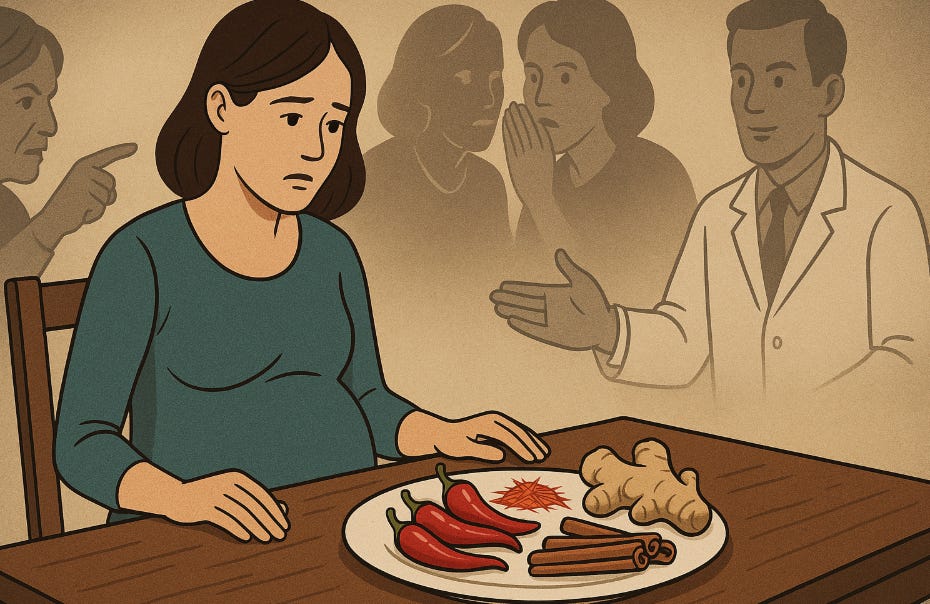
“Don’t eat the chili!” a worried aunt tells her pregnant niece at a family dinner. “It will make the baby come early.” Similar warnings are heard around the world: avoid cinnamon, ginger, parsley, or saffron, lest they “provoke miscarriage.” For something as small as a pinch of spice, the fear can feel outsized. Yet these warnings persist across generations, whispered in kitchens, reinforced by elders, and carried even into modern prenatal care.
Why do spices and herbs—foods that give life its flavor and often provide real health benefits—become symbols of danger in pregnancy? The answer lies at the intersection of biology, culture, and memory.
Spicy Foods and the Early Labor Myth
The most common global taboo is that spicy foods trigger contractions and lead to preterm birth. Ask almost any pregnant woman, and she will have heard some version of this advice.
The science:
There is no evidence that chili peppers, curries, or hot sauces can induce labor.
Capsaicin, the compound that gives chili its fiery taste, stimulates nerve endings in the mouth and digestive tract. It can cause a burning sensation in the stomach or intestines, but it does not reach the uterus.
Some women experience cramping or loose stools after a spicy meal. These digestive symptoms may be misinterpreted as uterine contractions, fueling the myth.
Interestingly, late in pregnancy, some women intentionally try spicy food as a “natural induction.” Surveys show that nearly one in five women has attempted this. Research consistently finds no effect: spicy food is no more likely than a walk around the block to start labor. At most, you’ll end up with heartburn—already a common discomfort when the baby presses on the stomach.
Herbs with a Reputation as Abortifacients
If chilies are feared for causing premature labor, certain herbs are thought to be even more dangerous: capable of ending a pregnancy altogether.
Historical roots:
Ancient Greek medical texts described parsley and rue as plants that could “expel the fetus.”
In medieval Europe, women were warned against saffron, aloe, and mugwort.
Pennyroyal, a mint relative, was used as an abortifacient as recently as the 19th century.
The science:
Most culinary herbs are safe in normal food amounts. A sprig of parsley or a cup of ginger tea does not threaten pregnancy.
Problems arise with concentrated forms—oils, tinctures, or capsules. Pennyroyal oil is a stark example: it can damage the liver and has caused both miscarriages and maternal deaths.
High doses of saffron may increase uterine activity, though the small amounts used in cooking are harmless.
Ginger, cinnamon, and turmeric are generally safe, but extremely high doses of supplements can cause gastrointestinal upset or interact with medications.
So while taboos around everyday food use are exaggerated, the warnings carry a faint echo of truth when applied to medicinal-level doses.
Why Spices Attract Suspicion
Spices are intense, colorful, and often exotic. In ancient trade networks, they were worth more than gold. Their rarity and potency gave them symbolic weight: they were linked to fertility, sexuality, and sometimes witchcraft.
For pregnant women, whose condition was viewed as delicate and precarious, anything powerful was to be avoided. Better safe than sorry. The logic was simple: if a plant could heat the body, stimulate the senses, or purge the bowels, perhaps it could also disturb the womb.
There is also a deeper social meaning. Pregnancy taboos often regulate women’s appetites and behaviors. To tell a woman, “Don’t eat chili,” is also to assert control over her choices, reflecting cultural anxieties about reproduction and female autonomy.
Cultural Variations in Spice Taboos
India: Within Ayurvedic tradition, foods are classified as “hot” or “cold.” Pregnant women may be told to avoid hot foods like chilies, papaya, or pineapple, believed to disturb balance and provoke miscarriage. Yet these same foods are sometimes encouraged in the final days of pregnancy, to “bring on labor.”
Latin America: Garlic and onion are sometimes restricted, thought to affect the baby’s temperament or cause excessive crying after birth.
China: In traditional Chinese medicine, strong spices like ginger or cinnamon are considered warming. While small amounts may support health, excess is believed to upset harmony and threaten pregnancy.
Africa: In parts of West Africa, bitter or spicy herbs are avoided, thought to cause weakness in the newborn or interfere with breastfeeding later.
Though the details differ, the underlying theme is similar: extremes of flavor or potency are seen as destabilizing to the pregnant body.
What Modern Medicine Recommends
Doctors today offer a clear but nuanced message:
Spices in food amounts are safe. Curry, salsa, ginger tea, and cinnamon buns are not harmful.
Concentrated supplements are different. Oils, tinctures, or pills can reach levels that are unsafe. Always consult a healthcare provider before using herbal remedies.
Comfort matters. Pregnancy often brings reflux, nausea, and constipation. Spicy or heavily seasoned foods may worsen these symptoms. If a food makes you miserable, avoid it—but for your comfort, not for fear of harming the baby.
This approach bridges respect for tradition with evidence-based reassurance.
Practical Takeaways for Pregnant Women and Families
Enjoy your food. Flavorful meals bring joy and nutrients. Do not deprive yourself of safe pleasures based on myths.
Watch the form. A pinch of saffron in rice is fine. A capsule of saffron extract is not.
Check the source. Herbal teas and remedies vary in strength and quality. Always discuss supplements with a clinician.
Be gentle with your body. If chili or garlic makes you uncomfortable, listen to your body and cut back.
Balance tradition with science. Cultural wisdom may guide, but medical evidence can clarify what is truly risky.
Reflection
Food taboos around spices reveal how cultures respond to the unseen dangers of pregnancy. In the absence of modern science, communities relied on symbolic reasoning: strong foods could cause strong reactions. These beliefs helped protect women from overexposure to unknown substances, but they also restricted them unnecessarily.
Today we know better. The real threats lie not in a spoonful of curry but in misinformation that adds stress and guilt to an already demanding time.
So here is the question I leave with you: when tradition tells a pregnant woman “no” but science says “yes,” how can doctors and families work together to give her confidence without dismissing cultural heritage?