
Forbidden Foods II: Meat, Fish, and Eggs – Shellfish Taboos, Raw Fish Fears, and Cultural Restrictions
Are these safe to eat?

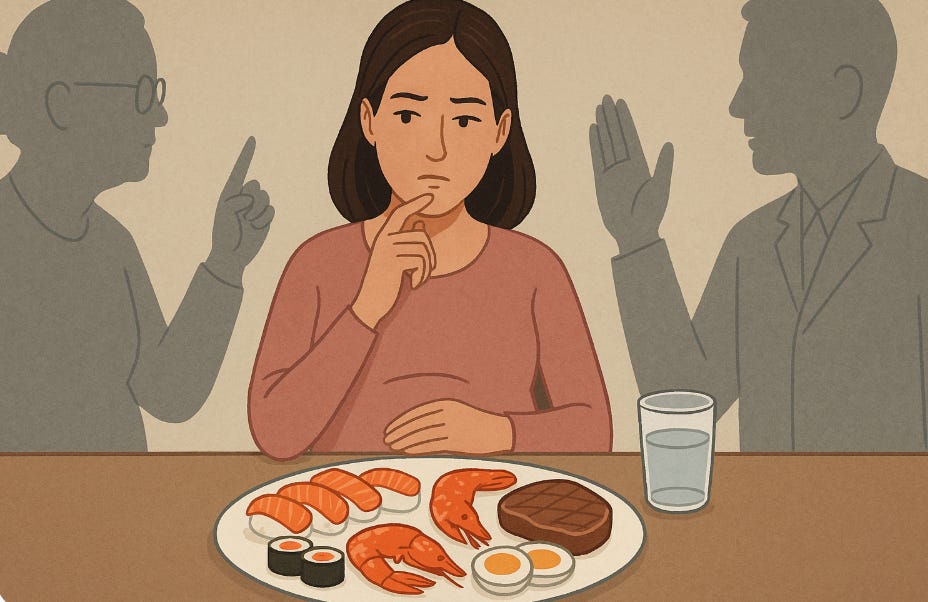
A pregnant woman sits in a bustling sushi restaurant, menu in hand. Her friends encourage her to order the salmon sashimi she has always loved, but she shakes her head. “Not while I’m pregnant,” she whispers. In another part of the world, a grandmother insists her pregnant daughter-in-law avoid shellfish, claiming it will make the baby weak. Across cultures and generations, animal-based foods have sparked some of the most enduring pregnancy taboos.
Why do meat, fish, and eggs—foods rich in protein, vitamins, and essential fats—so often become the subject of restrictions and fears? Let’s explore what science and culture each bring to the table.
Shellfish: The Ancient Taboo
Shellfish have been viewed with suspicion for centuries. In the Hebrew Bible, Leviticus forbids shellfish consumption altogether, a law that continues in Jewish dietary practice today. Similar proscriptions exist in Islam, Hinduism, and some African traditions.
For pregnant women, shellfish taboos often carry a stronger edge. Elders may warn that shrimp or crab could cause deformities, miscarriage, or illness. While these claims are not supported by medical evidence, there is a kernel of truth in avoiding shellfish under certain conditions.
The science:
Bacterial contamination: Shellfish can harbor Vibrio, Salmonella, and Listeria. Pregnant women are more vulnerable to severe infection, which can harm both mother and baby.
Heavy metals: Certain shellfish can accumulate mercury, arsenic, or cadmium. Regular high intake raises concern.
Allergens: Shellfish allergies are among the most common and can appear suddenly, even in adulthood.
So while there is no need for blanket avoidance, shellfish must be cooked thoroughly and consumed in moderation. The problem is not the species itself, but the handling and preparation.
Raw Fish: The Sushi Controversy
Few taboos cause more debate than sushi in pregnancy. In the United States, medical authorities generally advise against raw fish, mainly due to the risk of parasites and bacterial infections. Yet in Japan, sushi is often part of traditional pregnancy diets, valued for its high-quality protein and omega-3 fatty acids.
What explains this divide?
Different food safety standards: Japan enforces strict guidelines on how fish for raw consumption is handled and frozen. This greatly reduces parasite risk.
Cultural expectations: Japanese physicians may focus less on prohibition and more on balance and moderation, while American physicians emphasize risk avoidance.
Public health context: In countries with higher rates of foodborne illness, broad warnings make sense.
The science:
Parasites like Anisakis can cause severe illness, though freezing at –20°C for at least 7 days kills them.
Listeria infection, rare but dangerous, is more concerning in pregnancy.
Cooked fish offers nearly the same nutritional benefits without the infection risk.
Bottom line: Sushi quality and safety vary widely. For most pregnant women outside Japan, avoiding raw fish is prudent.
Meat: From Sacred to Suspect
Meat, central to many diets, is also a frequent target of restrictions. In some cultures, pregnant women are encouraged to eat more meat to strengthen the baby. In others, especially vegetarian traditions in India, abstinence is framed as spiritually purer or easier for digestion.
The science:
Undercooked meat carries risks of Toxoplasma gondii, a parasite that can cause serious congenital infection.
Processed meats (like deli slices, hot dogs, or pâtés) may harbor Listeria.
Red meat is high in iron, a crucial nutrient during pregnancy. Deficiency increases the risk of anemia, preterm birth, and low birth weight.
This tension—between risk of infection and need for nutrition—explains why taboos flourish. Meat is both vital and potentially dangerous. Cooking meat thoroughly is the safest path.
Eggs: Fragile Symbol of Life
Eggs, with their perfect symbolism of fertility, also inspire caution. In some communities, pregnant women are warned that eating too many eggs will cause a baby to grow too large, making childbirth difficult. In others, eggs are avoided because they are “hot” foods in the system of traditional Chinese medicine, thought to disturb the body’s balance.
The science:
Raw or undercooked eggs can carry Salmonella.
Fully cooked eggs, however, are excellent sources of protein, vitamin D, and choline, which supports fetal brain development.
Eating eggs does not increase birth weight to dangerous levels; this is myth, not medicine.
Why These Taboos Persist
Food taboos during pregnancy often emerge where risk is invisible but consequences could be catastrophic. A grandmother who once saw a baby harmed after an infection may generalize the lesson: “No shellfish.” A physician in a country with lax food safety rules may give the same advice.
Taboos also express cultural values:
Purity and pollution (avoiding foods seen as unclean).
Control of female bodies during vulnerable periods.
Group identity and religious belonging.
What science adds is nuance. Instead of blanket prohibitions, evidence allows us to distinguish between unsafe practices (raw shellfish, undercooked meat, runny eggs) and safe ones (well-cooked versions of the same foods).
Practical Lessons for Today’s Families
Cook thoroughly: Shellfish, meat, and eggs are safe and healthy when properly cooked.
Be mindful with fish: Choose low-mercury species (salmon, sardines, trout) and avoid raw fish unless you are in a setting with proven safety standards.
Don’t fear nutrition: Protein, iron, omega-3 fatty acids, and choline are essential. Avoiding entire food groups can do more harm than good.
Respect culture, but question myths: Family advice often carries wisdom, but science can help refine it.
Reflection
Food taboos are not random. They emerge at the intersection of health, culture, and memory. For pregnant women, they can feel like both protection and restriction. The challenge for modern obstetrics is to respect cultural traditions while ensuring mothers receive the nutrition they and their babies need.
So here is the question I leave with you: When cultural taboos clash with scientific evidence, who decides what a pregnant woman should eat—her family, her doctor, or herself?