
Einstein, Buddhism, and the Mindful Universe of Pregnancy
The Human Factor: Einstein admired Buddhism for its humility before the unknown. Kahneman showed why we should too. Pregnancy may be where science, compassion, and uncertainty meet most profoundly.

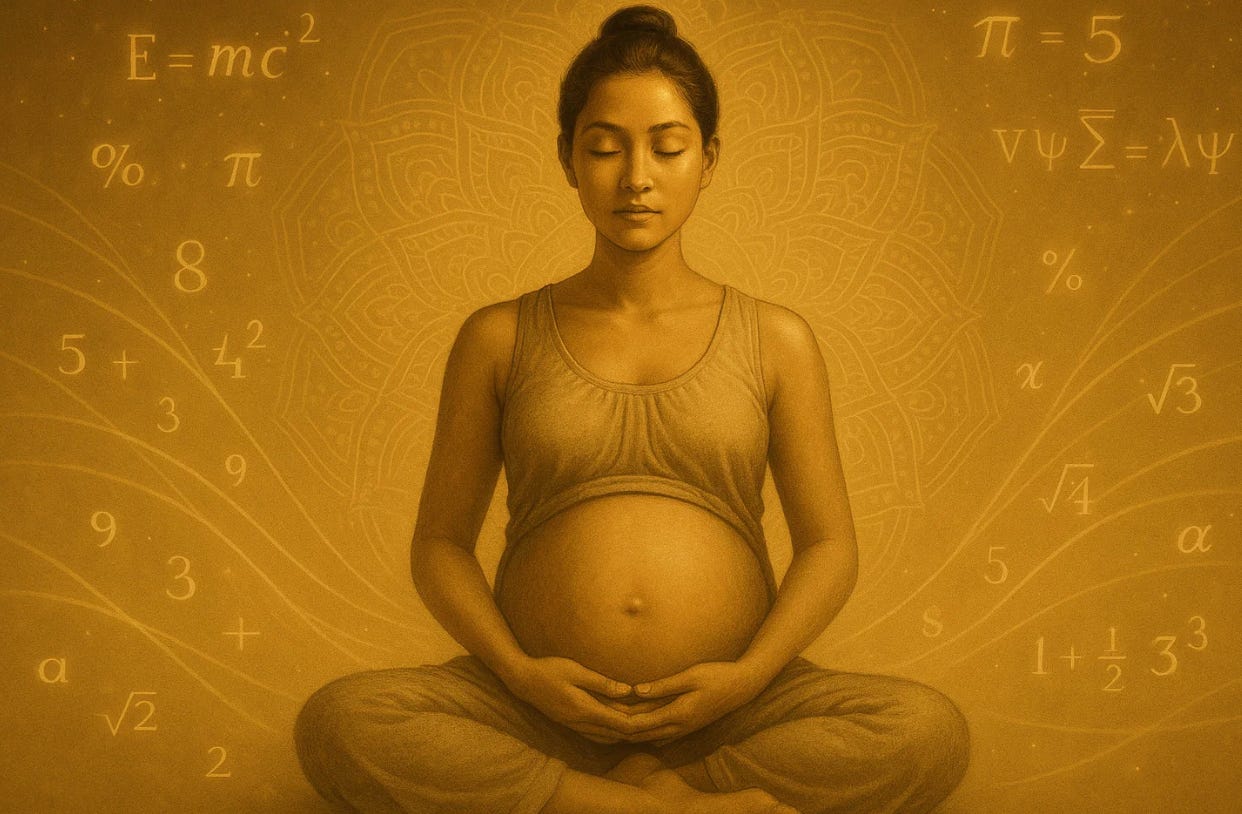
Albert Einstein, the famous scientist, once said that if there were any religion that could meet the needs of modern science, it would be Buddhism. He admired its lack of dogma, its embrace of uncertainty, and its respect for observation and balance. Strangely enough, those same principles describe the most profound state of observation there is — pregnancy.
The Physics of Being Pregnant
Pregnancy is not a mechanical process. It’s a living paradox. Two people exist within one body, yet biology finds equilibrium. The fetus, a genetic half-stranger, is tolerated by the maternal immune system, nourished by her blood, and protected by her mind’s vigilance.
Einstein would have found this remarkable. The notion that the universe — and life itself — seeks balance through invisible forces is at the heart of both relativity and Buddhism. In pregnancy, time and space are stretched too: a few weeks can feel like an eternity, and the body’s boundaries blur. The pregnant state bends the definition of self, much like gravity bends light.
The Buddhist Lens: Interconnection, Not Ownership
In Buddhist thought, the self is not fixed but fluid, part of an interconnected continuum. The same could be said of pregnancy. A mother does not “own” her fetus; she participates in its becoming. She shapes, protects, and sustains it, but she is also changed by it — hormonally, physically, emotionally, even genetically.
Microchimerism, for example, reveals that fetal cells can remain in a mother’s body for decades, influencing tissue repair and immune function. In a biological sense, pregnancy never truly ends. This echoes the Buddhist teaching of anatta — no permanent self, only a dynamic exchange of being.
Einstein’s view of the cosmos as “a single, infinite substance in motion” fits here too. The same atoms that form a newborn once pulsed in stars. Pregnancy is a microcosmic echo of cosmic unity.
The Ethical Parallels: Non-Attachment and Compassion
Modern obstetrics often focuses on control: predicting risks, scheduling inductions, quantifying outcomes. But pregnancy resists control. It humbles us. It reminds clinicians — and parents — that uncertainty is not failure but reality.
Buddhism teaches non-attachment, not as indifference, but as freedom from illusion. In prenatal care, this could mean letting go of the illusion of perfection: that every scan must be normal, every labor plan fulfilled, every baby’s path predictable. When obstetricians approach uncertainty with compassion rather than fear, medicine becomes wiser.
Einstein once said, “Our task must be to free ourselves from this prison by widening our circle of compassion to embrace all living creatures.” Pregnancy demands that expansion of compassion — from self to child, from patient to professional, from family to society.
Kahneman’s Wisdom: The Bias of Control
Daniel Kahneman, the psychologist and another Nobel prize winner who changed how we understand decision-making, would recognize the illusions at play in modern obstetrics. He showed that humans overestimate their ability to predict complex outcomes — what he called the illusion of validity. In pregnancy, that illusion can be deadly.
Doctors and parents alike often seek certainty where none exists: due dates that feel precise but aren’t, “low-risk” pregnancies that turn high-risk overnight, or fetal testing results framed as guarantees rather than probabilities. Kahneman warned that intuition can mislead even experts when emotion and expectation distort judgment.
His lesson fits seamlessly with Einstein’s humility and Buddhism’s mindfulness: true wisdom lies not in eliminating uncertainty, but in recognizing it — and still acting with care. A mindful clinician doesn’t promise certainty but builds trust amid ambiguity.
Science Meets Stillness
Einstein approached science like a mystic: he valued intuition, humility, and curiosity. “The most beautiful experience we can have,” he wrote, “is the mysterious.”
Pregnancy is full of mystery. A fertilized egg transforms into a conscious being through processes still partly unknown. Cells differentiate, organs self-assemble, the heart begins to beat without any external command. The obstetrician can measure and monitor, but not fully explain.
In Buddhism, the practice of mindfulness asks one to observe without judgment. In medicine, we call it clinical observation. But when practiced deeply — when we truly attend to a patient’s breath, tone, or silence — it becomes a moral act.
A Practical Re-Framing for Clinicians
What would a Buddhist-Einsteinian obstetrics look like? Probably not one obsessed with metrics, billing codes, or defensive documentation. It would emphasize presence over perfection, and humility over hierarchy.
A mindful obstetrician would see each patient not as a case but as a singular constellation of experience — shaped by genetics, environment, and emotion. The counseling room would become less about compliance and more about understanding. The ultrasound screen, less a verdict and more a moment of shared wonder.
Pregnancy, in this view, is not a problem to be managed but a relationship to be respected.
Reflection: The Relativity of Motherhood
Einstein taught us that time is relative: it stretches with gravity and speed. Pregnancy teaches us that love is too. For some, nine months feel endless; for others, they vanish in a blur. For the fetus, the womb is timeless.
Perhaps that is why both Einstein and the Buddha distrusted absolute truths — and why Kahneman warned against the false comfort of certainty. The pregnant body, like the universe, thrives in paradox: independent yet connected, fragile yet enduring, mysterious yet real.
If modern obstetrics borrowed a little more from Einstein’s curiosity, Buddhism’s compassion, and Kahneman’s humility about the mind’s limits, we might rediscover that pregnancy is not only a biological event but a moral and cosmic one — a reminder that life, like light, bends beautifully under the weight of love.