
Doctors Hallucinate Too: Why Medicine Should Be Careful Before Casting Stones at AI
Doctors have been “hallucinating” diagnoses for generations, causing hundreds of thousands of deaths each year. Maybe medicine should fix its own errors before condemning AI for making the same ones.

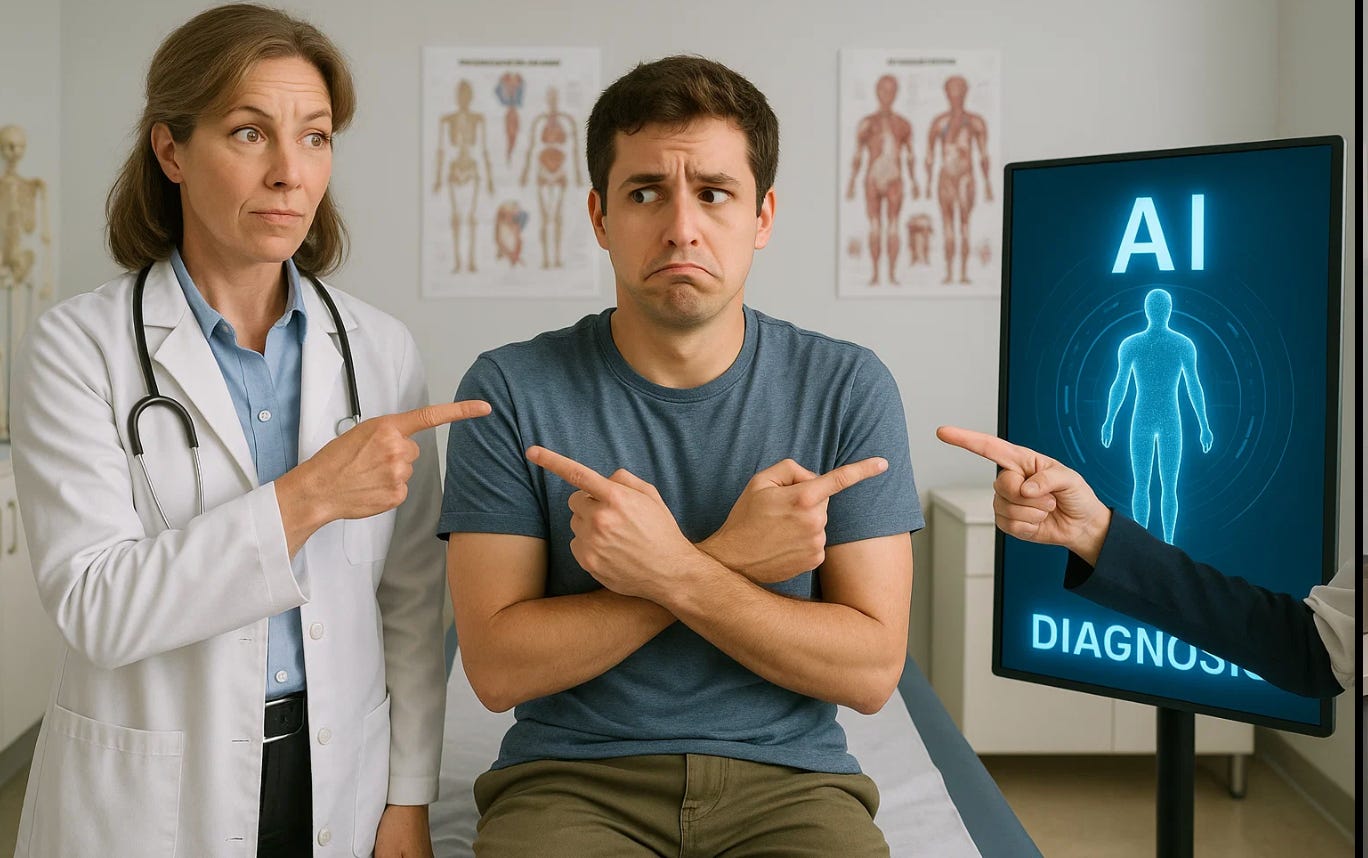
Generative AI has been branded with a scarlet letter: hallucinations. Every time a chatbot produces a confident but false statement, critics rush to declare the technology untrustworthy, dangerous, or even existentially risky. Depending on the task, studies show hallucination rates anywhere between 5 and 30 percent. That sounds bad, and in a vacuum it is. But here’s the inconvenient comparison: doctors hallucinate too, and when they do, the consequences are measured not in headlines but in human lives.
The Medical Error Epidemic
Each year in the United States, medical errors kill an estimated 250,000 to 440,000 people. That’s not a typo. If medical error were classified as a disease, it would rank as the third leading cause of death in America, right behind heart disease and cancer. Diagnostic errors affect ten to fifteen percent of patient encounters. Medication mistakes—wrong doses, wrong drugs, wrong patients—occur in five to ten percent of all orders. The numbers are staggering, and they’ve been known for decades.
Yet the medical profession treats them as an unfortunate but inevitable byproduct of human practice. Liability is blunted by malpractice caps. Accountability is diffused by peer protection systems. And when things go wrong, the culture of medicine reliably points to “the system” rather than to individual responsibility. Some of that deflection is justified, but it also conveniently shields the profession from real reckoning.
The Double Standard
Contrast that with how we treat artificial intelligence. An AI model produces a fabricated citation or an inaccurate summary, and the reaction is immediate: outrage, scrutiny, regulatory hearings. AI hallucinations have become the stuff of op-eds, Senate inquiries, and anxious calls for moratoriums. Yet no one has died from an AI hallucination. The worst that happens is a researcher wastes time chasing a phantom reference or a lawyer embarrasses themselves by citing a case that doesn’t exist.
The asymmetry is remarkable. Generative AI errors are embarrassing but not lethal. Physician errors are lethal but tolerated. We have normalized a world in which human hallucinations kill hundreds of thousands annually, while machine hallucinations that harm no one provoke existential panic.
Hallucinations in White Coats
Doctors would never use the word, but they hallucinate diagnoses all the time. A patient with chest pain is told it’s indigestion when it’s really a heart attack. Another with sudden weakness is reassured it’s vertigo, when it’s a stroke. A child’s rash and fever is waved off as “just viral” when meningitis is the real culprit. These are not moral failings. They are confident but false judgments—clinical hallucinations rooted in bias, fatigue, and the limits of human cognition.
In this sense, the resemblance to AI is uncanny. Both humans and machines rely on pattern recognition. Both extrapolate from incomplete data. Both are capable of producing confident nonsense in the face of uncertainty. The difference is that when AI hallucinates, it becomes a scandal; when doctors hallucinate, it becomes a statistic.
Why the Discomfort?
The medical profession bristles at the comparison because it cuts against its own mythology. Doctors are trained, credentialed, and entrusted with lives. The suggestion that they might be no less prone to confident error than a machine is deeply unsettling. Yet the data don’t lie. For generations, physicians have caused preventable harm at a scale that dwarfs anything AI has done. The only reason this doesn’t dominate headlines is that it has been quietly absorbed into the background noise of healthcare.
The irony is that many of the same doctors who dismiss AI because of hallucinations are practicing within a system that accepts human hallucinations as the cost of doing business. If we demanded from medicine the same perfection we now demand from machines, the entire profession would collapse under the weight of its own error rate.
What Should Be Done?
This is not an argument to excuse AI’s faults. It is a call to perspective. Both humans and machines are fallible, but their errors need not be additive. If deployed responsibly, AI can serve as a double-check against human mistakes, just as humans can verify machine outputs. A doctor prone to premature closure in diagnosis may benefit from an AI that raises alternative possibilities. An AI prone to fabricating references can be kept in check by a human with the judgment to verify. Together, they can mitigate each other’s weaknesses.
But that will only happen if medicine moves past its defensiveness. Criticizing AI for hallucinations while tolerating its own amounts to hypocrisy. Worse, it risks depriving patients of a technology that, for all its imperfections, may ultimately save lives by reducing the staggering toll of human error.
Reflection
Doctors hallucinate too. They always have. They regularly make medical mistakes which kill 100s of thousands each year. The difference is that when physicians hallucinate, real people suffer and die, while when AI does, we get a flurry of think pieces. Before medicine casts stones at emerging technologies, it might do well to reckon honestly with its own fallibility. The ethical question is not whether AI is imperfect—it is whether we are willing to accept imperfection in humans while demanding the impossible from machines.