
The Safety Ledger: Doctor, Nurse, and Keyboard Walk Into a Room…
Medicine promised efficiency through digital charts. What we got was a system that clicks more than it cares.


Imagine you sit down at a restaurant. The waiter greets you warmly, but before handing you a menu, he sits at a laptop. For each glass of water, he must fill in 20 data points: temperature, garnish, time of delivery, the angle of your napkin. The server brings out your entrée, but before serving it, he logs every stir of the spoon into a form. The food eventually arrives, but the experience is cold and delayed.
That, in short, is what electronic medical records (EMRs) have done to healthcare. The meal is the same, but the service has changed. Same number of staff compared to 20 years ago but now their responsibilities have shifted. Two decades after EMRs were introduced with promises of clarity, safety, and efficiency, doctors and nurses find themselves spending more time typing about care than delivering it.
The Great Promise, the Great Tax
Let’s be fair. EMRs solved some very real problems. No more illegible scrawls in paper charts. No more missing allergy lists. No more results lost in the basement file room. Coordination across sites improved. Patients could finally access parts of their own record.
But efficiency came with a hidden tax: time. Nurses now spend roughly half their shift in the EMR. A systematic review found median documentation time around 50% of working hours, with a mean of 56.6%—and in some cases nearly all of a shift (1). Physicians are in the same boat. A landmark study showed that primary care doctors devoted nearly two hours to the EMR for every one spent with patients. Only about 27% of their day involved direct, face-to-face care (2).
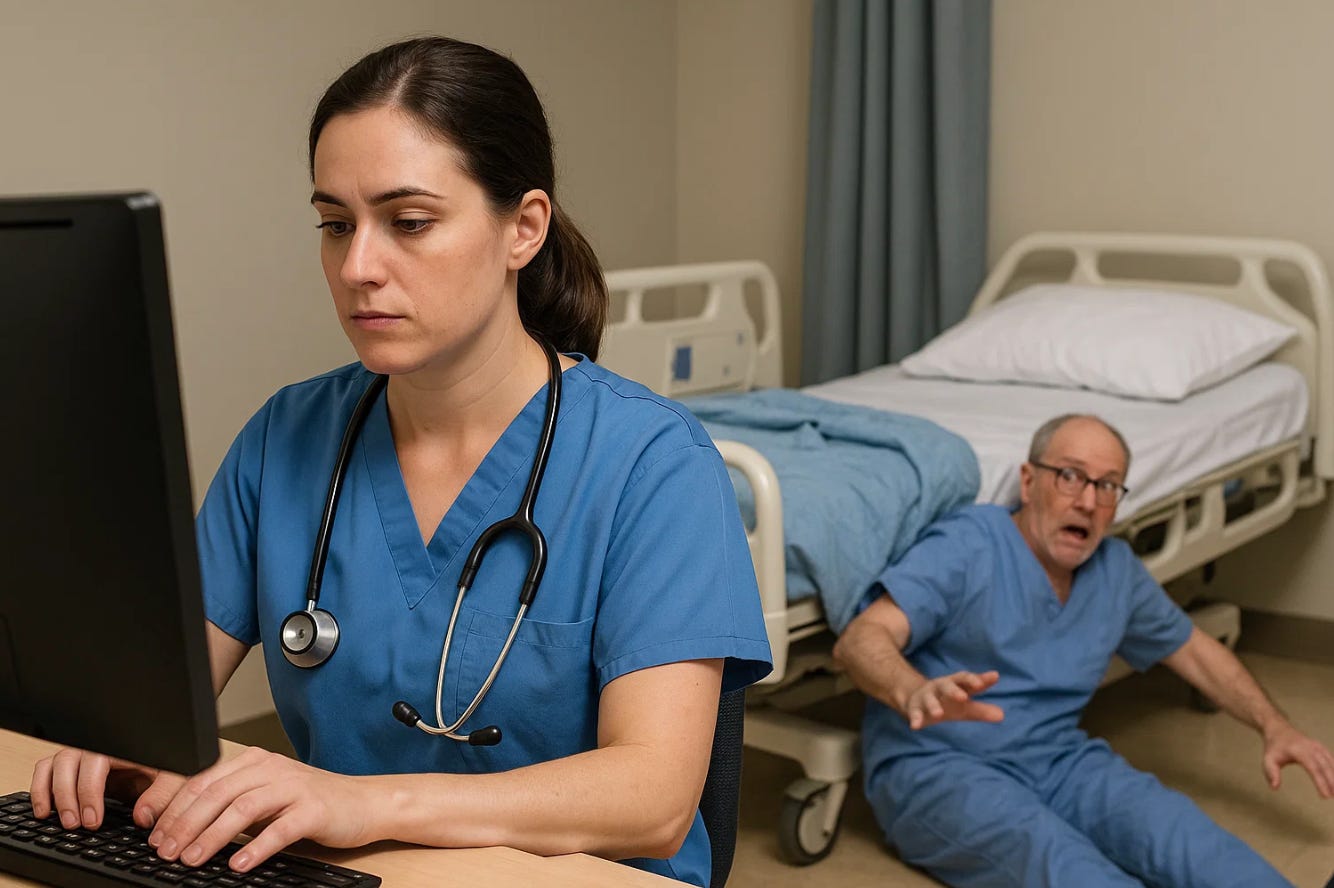
If you are lying in a hospital bed, that means the glowing screen gets more eye contact than you do.
The Hospital Paradox
You might think hospitals would notice this imbalance and ask how to fix it. Instead, most do the opposite. Each year, new “required fields” are added: compliance checkboxes, billing prompts, safety audits, quality metrics. Everyone gets to add their slice of the pie; no one ever takes a slice away.
Hospitals measure whether forms are completed, but rarely measure how long it takes. They boast of better coding, but not of how much bedside time is lost in the process. If EMRs were a house, they would look like a mansion patched together with endless hallways and staircases, none of which were ever torn down. Nurses and doctors are the ones running around inside, exhausted, while patients wait.
What Gets Lost
The losses are not abstract. They are human. A nurse, eyes fixed on the monitor, may miss the subtle change in a patient’s skin color or the whispered “I don’t feel right.” A physician, clicking through templates, risks making eye contact with the screen more than the person.
Burnout follows. Surveys show that most physicians see the EMR as a major source of stress and a reason to consider leaving practice (3). Nurses echo the same frustration. When half your professional life is devoted to documenting, the vocation starts to feel like data entry.
Patient safety also takes a hit. With so much to chart, shortcuts appear. Copy-paste notes proliferate. Alerts fire so often that they become background noise, ignored even when important. The record may look complete, but it does not always reflect reality.
Can It Be Fixed?
It does not have to be this way. The solution is not to scrap EMRs but to make them work for clinicians rather than against them. Hospitals could start by measuring documentation time as a key performance indicator. If every new requirement added a minute, something else should be removed.
Clinicians—both nurses and doctors—must be invited into the design process. They know where the extra clicks pile up. Simple changes like smarter templates, auto-filled defaults, or integrated voice transcription could restore hours. Patients themselves could enter data through portals, letting nurses and physicians focus on the parts only they can provide. Emerging AI “scribes” hold promise too, though they must be carefully tested for accuracy and safety.
But perhaps the most important change is cultural. Documentation should serve patient care, not the other way around. Right now, the EMR feels like the master and the caregiver the servant. And when hospitals proudly advertise “patient-centered care,” the irony is painful. How “centered” can care be when the patient is literally off to the side, waiting for the nurse or doctor to finish clicking through endless screens? In many hospitals, computers are even wheeled into the room on carts called COWs—“computers on wheels.” The dark joke among staff is that patients now see more of the COW than of the clinician.The rhetoric of patient-centeredness sounds noble, but in daily practice it often becomes oblivious to reality—because the center of gravity has shifted to the record, not the person in the bed.
Reflection
Two decades in, we must ask: do we work for the record, or does the record work for us? When nurses spend more than half their shift charting and doctors spend more time with a keyboard than with a patient, something fundamental is lost.
If the screen steals the caregiver’s gaze, then the EMR is no longer a tool. It is a barrier. The next 20 years should not be about more fields, more boxes, more alerts. They should be about giving time back—so that the nurse can notice the sigh, the doctor can hear the story, and the patient once again feels seen.
References
Stevens LA, Abramson EL, Wu WY, Kinoshita L, Cornell K, Stetson PD. Electronic health record use by nurses in acute care settings: A scoping review. J Am Med Inform Assoc. 2021;28(5):998-1008. doi:10.1093/jamia/ocaa270.
Sinsky C, Colligan L, Li L, Prgomet M, Reynolds S, Goeders L, et al. Allocation of physician time in ambulatory practice: a time and motion study in 4 specialties. Ann Intern Med. 2016;165(11):753-60. doi:10.7326/M16-0961.
Collier R. Electronic health records contributing to physician burnout. CMAJ. 2017;189(45):E1405-E1406. doi:10.1503/cmaj.109-5522.