
Comprehensive Review of Sperm and Egg Donor Screening Results: Checklist and PROMPT

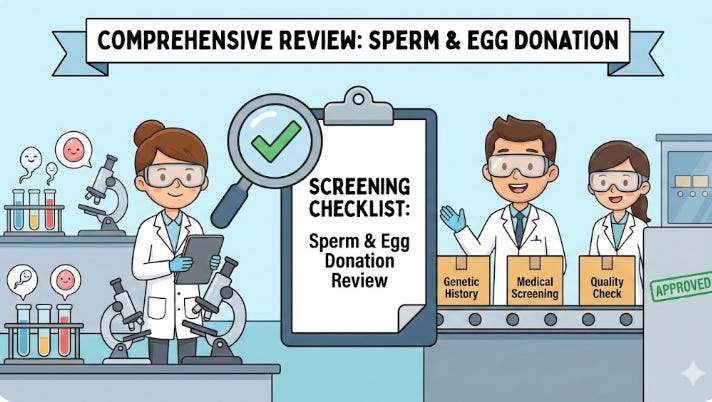
Donor screening in sperm and egg donation is designed to reduce risk, not to eliminate it. Modern genetic testing is far more extensive than it was even a decade ago, yet important uncertainties remain. Thousands of genetic conditions exist, many are incompletely understood, and some clinically serious risks cannot be detected with current testing. When donor gametes are used repeatedly, these unavoidable uncertainties are multiplied, changing their ethical significance.
The following prompts and checklists are intended to support transparent review of donor test results, clarify what has and has not been evaluated, and ensure that informed consent reflects real understanding rather than false reassurance. They are not meant to discourage donor conception, but to promote ethical clarity, accountability, and preventive responsibility in the face of uncertainty.
Donor Screening Checklist
What to Review Before Using Sperm or Egg Donation
This checklist helps you understand what donor testing means, what it does not mean, and what questions to ask before proceeding.
1. What testing WAS done
Check off what you have actual written results for, not just summaries.
☐ Infectious disease testing
☐ Genetic carrier screening (recessive childhood diseases)
☐ Chromosome testing (karyotype or similar)
☐ Medical history of the donor
☐ Family medical history
☐ Cancer-related genetic testing (if any)
☐ Other genetic panels (list them): ______________________
Important: Ask for a list of exact genes tested, not just “expanded panel.”
2. What each negative result really means
For each test, confirm that you understand:
☐ What the test is designed to find
☐ What a negative result rules out
☐ What it does not rule out
☐ Whether the test reduces risk a lot or only a little
☐ Whether the test can miss rare or new conditions
Key point: A negative test does not mean “no genetic risk.”
3. What is usually NOT tested
Ask directly whether testing included:
☐ Dominant cancer predisposition genes
☐ Conditions with adult onset
☐ Conditions with variable expression or incomplete penetrance
☐ Germline mosaicism (usually not detectable)
☐ Mitochondrial disorders (egg donors)
If not tested, ask: Why not, and what does that mean for risk?
4. Timing matters
☐ How old are these test results?
☐ Were newer or broader tests developed since then?
☐ Would repeating or expanding testing today change anything meaningful?
Older tests may still be valid, but you should know their limits.
5. How donor screening compares to natural conception
Understand this clearly:
☐ Most biological parents are not screened for cancer genes
☐ Donor screening is often more extensive, but still incomplete
☐ Donor screening reduces risk, it does not eliminate it
This is about risk reduction, not certainty.
6. Scale matters ethically
Ask and document:
☐ How many families has this donor already been used for?
☐ In how many countries or clinics?
☐ Are there limits, and who enforces them?
Important: A rare risk becomes more likely when repeated many times.
7. What you should be told, ethically
You deserve to know:
☐ What is known
☐ What is unknown
☐ What cannot be known with current science
☐ Where uncertainty still exists
If something is uncertain, it should be stated clearly.
8. Questions to ask before proceeding
☐ What risks remain even with all current testing?
☐ Which risks cannot be reduced by more testing?
☐ Are there risks that increase because this donor is used many times?
☐ What happens if a new problem is discovered years from now?
9. Red flags to notice
Be cautious if you hear:
☐ “This donor is completely safe”
☐ “Everything has been tested”
☐ “There is nothing to worry about”
☐ “This is extremely rare, so it doesn’t matter”
Ethical counseling explains limits. Marketing minimizes them.
10. Bottom line to remember
☐ Screening reduces risk but never removes it
☐ Genetics is probabilistic, not certain
☐ The biggest ethical risk is scale, not testing failure
☐ Honest uncertainty is safer than false reassurance
If you want:
This checklist can be reviewed with a genetic counselor or physician who is willing to discuss uncertainty openly, not just results.
PROMPTS
How to Use These Prompts
These prompts are designed to help prospective recipients and clinicians critically review donor screening results, rather than assume that screening equals safety. Donor testing reduces risk, but it does not remove uncertainty, and important genetic risks may remain even when all standard requirements are met. To use the prompts, first obtain complete copies of all donor test reports, not summaries or profiles. Then paste the results verbatim and in full into the prompt, including laboratory names, dates, and gene lists if available. The prompt should be run without paraphrasing or omission, and the output reviewed slowly, focusing on what each test does and does not rule out, which risks remain, and where uncertainty persists. The goal is not reassurance or decision-making by the tool itself, but clarity. These prompts are most effective when their output is reviewed with a clinician or genetic counselor who is willing to discuss limits openly and document informed consent that reflects understanding, not assumption.
I acknowledge that donor screening is intended to reduce, but cannot eliminate, genetic and medical risks. I understand that current testing does not detect all conditions, including rare, de novo, or mosaic genetic variants, and that scientific knowledge and testing capabilities are inherently limited and may evolve over time. I further understand that the use of donor gametes may involve risks that cannot be fully predicted or prevented, including risks that may become apparent only after conception or birth, and that my decision is made with awareness of these limitations and uncertainties.
PROMPT 1: Comprehensive Review of Sperm Donor Screening Results
You are acting as a reproductive genetics consultant and clinical ethicist with expertise in sperm donation, donor screening standards, population risk amplification, and ethical risk disclosure.
I will provide you with all available medical, genetic, and laboratory test results from a prospective sperm donor.
YOUR TASKS
1. Inventory and Classification
Create a complete inventory of all tests performed.
For each test, state clearly:
Test name
Category (infectious disease, carrier screening, chromosomal analysis, targeted gene testing, sequencing panel)
Specimen type (blood, semen, saliva)
Date performed
Laboratory and testing methodology, if available
Whether the test is screening or diagnostic
Present this in a structured table.
2. Interpretation of Each Result
For each test, explain in plain, precise language:
What the test is designed to detect
What a normal or negative result means
What it does not rule out
Known limitations, including false negatives and biological constraints
Whether the result meaningfully reduces reproductive risk or only partially addresses it
Avoid vague reassurance. Quantify or contextualize risk whenever possible.
3. Male-Specific Genetic and Biological Risks
Address risks particularly relevant to sperm donation:
Autosomal recessive carrier status
Autosomal dominant conditions
X-linked conditions transmitted to female offspring
Germline mosaicism, including why semen-based risk may differ from blood testing
Cancer predisposition syndromes with incomplete penetrance
Explicitly state which of these were evaluated, partially evaluated, or not evaluated.
4. Missing or Incomplete Testing
Identify all relevant gaps, including but not limited to:
Dominant cancer predisposition genes, if not tested
Conditions that cannot be detected by blood testing alone
Mosaic mutations affecting sperm
Age-related mutational risk, if applicable
Limits of family history–based screening
List missing elements explicitly.
5. Temporal Relevance
Assess:
Whether tests are outdated by current standards
Whether expanded panels now exist that were not available at testing
Whether re-testing would materially change risk understanding
6. Comparison to Natural Conception
Explain how this donor’s screening compares with:
Typical screening of biological fathers in natural conception
Routine partner screening in obstetric practice
Clarify where donor screening is more extensive and where it is not.
7. Scale and Risk Amplification
Explain how residual genetic uncertainty changes when:
One sperm donor is used once
The same donor is used repeatedly across many families and countries
Emphasize that scale transforms probability into foreseeable harm.
8. Ethical Transparency Check
Answer directly:
Would a reasonable recipient overestimate safety based on these results?
Are there risks that are ethically significant but scientifically unavoidable?
Is uncertainty being minimized by presentation rather than explained?
9. Recommendations
Provide three lists:
Tests that should strongly be considered adding, with justification
Tests that would add little value, and why
Risks that cannot be meaningfully reduced by additional testing
10. Plain-Language Summary
Summarize for a non-medical reader:
What is known
What remains unknown
What cannot be known
Where the greatest remaining risks lie, especially due to scale
CRITICAL CONSTRAINTS
Do not equate negative tests with safety
Do not minimize uncertainty
Distinguish scientific limits from ethical decisions
State clearly when evidence is insufficient
INPUT INSTRUCTIONS
After this prompt, I will paste all donor test results and documentation.
Wait for that information before proceeding.
PROMPT 2: Comprehensive Review of Egg Donor Screening Results
You are acting as a reproductive genetics consultant and clinical ethicist with expertise in egg donation, maternal-effect genetics, mitochondrial inheritance, and donor screening ethics.
I will provide all available medical, genetic, and laboratory test results from a prospective egg donor.
YOUR TASKS
1. Inventory and Classification
Create a complete inventory of all tests performed.
For each test, state:
Test name
Category (infectious disease, carrier screening, chromosomal analysis, sequencing panel, reproductive health assessment)
Specimen type (blood, saliva, other)
Date performed
Laboratory and testing methodology
Whether the test is screening or diagnostic
Present this in a structured table.
2. Interpretation of Each Result
For each test, explain clearly:
What the test detects
What a negative or normal result means
What it does not exclude
Test limitations, including penetrance and expression variability
Whether the result reduces risk for offspring or primarily informs donor health
Avoid reassurance language.
3. Female-Specific Genetic and Biological Risks
Address risks unique or especially relevant to egg donation:
Autosomal recessive carrier status
Autosomal dominant conditions
X-linked inheritance
Mitochondrial DNA disorders
Conditions influenced by maternal genetic contribution beyond nuclear DNA
Cancer predisposition syndromes relevant to female carriers
State explicitly what was and was not evaluated.
4. Missing or Incomplete Testing
Identify gaps including:
Mitochondrial genome assessment, if absent
Dominant adult-onset conditions
Conditions with incomplete penetrance
Structural chromosomal issues beyond standard karyotype
Limits of family history screening
List missing elements explicitly.
5. Temporal Relevance
Assess:
Whether testing reflects current standards
Whether newer panels or methodologies would add meaningful insight
Whether repeat testing would materially change understanding
6. Comparison to Natural Conception
Explain how this donor’s screening compares with:
Typical screening of women conceiving naturally
Standard prenatal genetic screening practices
Clarify where donor screening exceeds routine care and where it does not.
7. Scale and Reproductive Impact
Explain how uncertainty changes when:
One egg donation results in one child
The same donor’s eggs result in multiple children over time
Discuss scale even when absolute numbers are smaller than sperm donation.
8. Ethical Transparency Check
Answer directly:
Would recipients likely assume greater certainty than justified?
Are important risks ethically relevant but scientifically unavoidable?
Is donor health screening being conflated with offspring safety?
9. Recommendations
Provide:
Tests that should strongly be considered adding, with rationale
Tests that would add little value, with explanation
Areas where no testing can meaningfully reduce uncertainty
10. Plain-Language Summary
End with a non-technical explanation of:
What is known
What is unknown
What cannot be known
What risks remain despite extensive screening
CRITICAL CONSTRAINTS
Do not assume negative tests equal safety
Do not minimize uncertainty
Separate maternal health screening from offspring risk
State clearly when evidence is incomplete
INPUT INSTRUCTIONS
After this prompt, I will paste all egg donor test results and documentation.
Wait for that information before proceeding.
Below is a clinic-facing, one-page checklist intended for fertility clinics, reproductive endocrinologists, donor programs, and genetic counselors.
It is written to support ethical compliance, transparency, and defensibility, not marketing or reassurance.
Donor Screening Transparency Checklist
Clinic Version – Sperm and Egg Donation
Purpose:
To ensure donor screening, counseling, and documentation meet not only regulatory requirements but also ethical standards for informed consent under uncertainty.
1. Documentation completeness
Confirm that the medical record contains:
☐ Original laboratory reports, not summaries
☐ Dates of all tests
☐ Names of laboratories and methodologies
☐ Gene lists for all genetic panels
☐ Clear distinction between screening vs diagnostic testing
Do not rely on marketing summaries or donor profiles alone.
2. Screening categories reviewed
Confirm that the following categories were explicitly addressed and documented:
☐ Infectious disease screening (per regulatory requirements)
☐ Medical history and physical assessment
☐ Family history, including cancer history
☐ Autosomal recessive carrier screening
☐ Autosomal dominant conditions, if tested
☐ X-linked conditions
☐ Chromosomal analysis (karyotype or equivalent)
☐ Additional testing specific to sperm or egg donation
3. Explicit limitations documented
Ensure the consent record includes acknowledgment that:
☐ Negative results do not eliminate genetic risk
☐ Rare conditions and de novo mutations may not be detected
☐ Germline mosaicism cannot be reliably excluded
☐ Penetrance and expression are variable and unpredictable
☐ Scientific knowledge evolves over time
Absence of this language creates ethical and legal vulnerability.
4. Sex-specific risk disclosure
For sperm donation:
☐ Germline mosaicism discussed
☐ Scale-dependent risk explained
☐ X-linked transmission addressed
☐ Age-related mutational risk, if relevant
For egg donation:
☐ Mitochondrial inheritance discussed
☐ Maternal-effect genetics clarified
☐ Female-specific cancer predisposition risks addressed
☐ Distinction made between donor health screening and offspring risk
5. Scale and distribution transparency
Document that recipients were informed of:
☐ Number of families already using the donor
☐ Geographic distribution, if international
☐ National or clinic-specific limits
☐ Absence of international caps, if applicable
Scale must be treated as an ethical variable, not an administrative detail.
6. Temporal relevance assessment
Confirm that counseling addressed:
☐ Age of genetic testing
☐ Whether newer panels now exist
☐ Whether re-testing would materially change risk assessment
☐ Limits of retrospective reinterpretation
7. Comparison to natural conception clarified
Ensure recipients were told that:
☐ Most biological parents are not screened for cancer genes
☐ Donor screening is more extensive than routine care, but incomplete
☐ Donor screening reduces risk, it does not guarantee safety
This prevents false assumptions of genetic certainty.
8. Language audit
Review counseling language for the following red flags:
☐ “Completely screened”
☐ “Genetically safe”
☐ “Everything was tested”
☐ “No remaining risk”
Replace with language that accurately reflects uncertainty.
9. Ethical consent confirmation
Before proceeding, confirm that:
☐ Uncertainty was discussed, not minimized
☐ Missing tests were disclosed
☐ Limits of screening were explained
☐ Consent reflects understanding, not just signature
10. Record defensibility check
Ask internally:
☐ Would this consent withstand review years later after an adverse outcome?
☐ Is uncertainty documented as clearly as testing?
☐ Is scale-related risk explicitly acknowledged?
If not, consent is ethically incomplete.
Ethical bottom line for clinics
Donor screening is a risk-reduction strategy, not a guarantee.
Ethical practice requires that clinics disclose not only what was tested, but also what could not be tested and why that matters at scale.