
Calculating Your Due Date by Moon Phase: Myth vs. Medicine
Calculating your due date by moon phases is unscientific and gets you the wrong dates


Pregnancy has always been surrounded by stories, rituals, and folk wisdom. One of the more enduring myths is that you can calculate your baby’s due date based on the phases of the moon. The idea is simple but seductive: the moon influences tides, water, and cycles, so surely it must shape pregnancy timing. Some people claim that conception and birth follow lunar rhythms, or that a “supermoon” predicts a surge of deliveries. But when we separate myth from medicine, the science tells a different story.
Where the Belief Comes From
Human cultures have long tied fertility and the moon together. A lunar cycle is about 29.5 days, close to the average menstrual cycle length. It is not surprising that people linked the waxing and waning of the moon with ovulation and birth. Midwives and traditional healers often relied on moon charts when other tools were unavailable. Even today, social media is full of posts suggesting that if you conceived on a full moon, your due date will align with the next full moon nine months later.
What the Science Says
Pregnancy length is measured in weeks, not moons. The standard method counts 40 weeks from the first day of the last menstrual period (LMP). Because ovulation usually happens about two weeks after the LMP, the true time from conception to birth averages 38 weeks.
Multiple large studies have looked at birth timing and lunar phases. The results are consistent: there is no reliable increase in births at the full moon, new moon, or any particular lunar phase. Obstetric wards may feel busier on certain nights, but when data are tracked over thousands of births, the moon does not predict the pattern.
Pregnancy is influenced by biology, not astrology. Hormonal changes, uterine signaling, and fetal readiness trigger labor—not lunar gravity. While the moon moves oceans, the gravitational effect on an individual human body is negligible compared with everyday influences like posture, fluid shifts, and exercise.
Why People Swear It Works
Myths often survive because of coincidence and selective memory. With 4 million births a year in the U.S., some babies will inevitably arrive on a full moon. Parents and nurses remember those nights more vividly than the countless uneventful ones. Social media amplifies these anecdotes, giving the illusion of a pattern where none exists.
There’s also comfort in thinking the cosmos is involved in something as profound as birth. The symbolism of the moon—its cycles, glow, and mystery—resonates deeply, especially during pregnancy, when so much feels out of human control.
The Real Way to Date a Pregnancy
The most accurate way to establish due dates today is by early ultrasound, ideally before 14 weeks, when crown-rump length gives a precise estimate of gestational age. LMP dating is useful if cycles are regular, but ultrasound trumps it if there’s a discrepancy. Even then, it is important to remember: only about 5% of women deliver on their exact due date. Most give birth within a window of about two weeks before or after.
So while the moon might make for a poetic birth story, it is not a reliable clock. Expecting mothers should understand due dates as estimates, not fixed appointments.
Example: Full Moon Anchor (Jan 25, 2024)
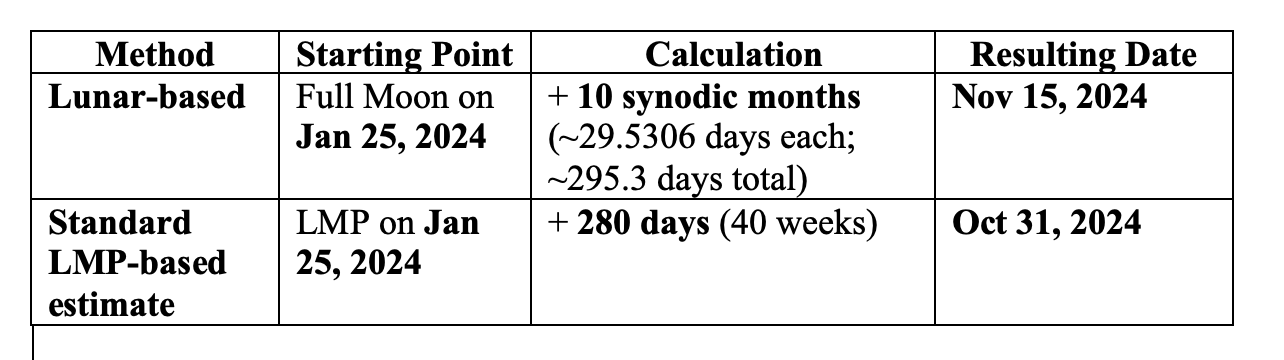
Difference: Lunar-based is 15 days later in this example.
Notes for readers:
“LMP + 280 days” is the conventional 40-week gestational estimate from the first day of the last menstrual period; it is not the same as Naegele’s historical month/day formula.
Lunar cycles vary slightly; using moons accumulates drift compared with clinical dating.
Early first-trimester ultrasound remains the most accurate method to establish due dates; LMP dating is a backup when cycles are regular.
Why Debunking Matters
At first glance, calculating due dates by moon phase may seem like harmless fun. The risk is when patients take it seriously, dismissing medical advice or feeling betrayed if their experience does not match the prediction. In obstetrics, precision matters—timing influences monitoring, induction, and interventions. Giving patients a false sense of certainty can delay necessary care.
Pregnancy already carries enough uncertainty. Our job as clinicians and educators is to provide tools that are grounded in evidence, while respecting the cultural meaning people attach to myths. The moon can inspire poetry and ritual, but when it comes to your baby’s birthday, trust the science over superstition.