
Breathing for Two: Air Pollution, Pregnancy, and the Hidden Risks to the Developing Brain
The Prognosis - What the latest evidence reveals about fine particulate exposure, autism, and how mothers can protect themselves and their babies.


Air pollution isn’t just a climate issue—it’s a prenatal health issue. A new 2.2-million–birth cohort shows that sulfate and ammonium pollution during pregnancy can subtly raise autism risk, underscoring why clean air must be part of maternal care
Pregnancy transforms every aspect of a woman’s physiology—and her environment matters just as much as her biology. A landmark 2025 Ontario cohort study of over 2.18 million births has drawn a sobering connection between prenatal air pollution exposure and the risk of autism spectrum disorder (ASD). The study, led by Cloutier and colleagues and published in JAMA Network Open, found that exposure to certain fine particulate matter (PM₂.₅) components, particularly sulfate (SO₄²⁻) and ammonium (NH₄⁺) during pregnancy, modestly increased the risk of ASD.
Autism spectrum disorder (ASD) is a neurodevelopmental condition characterized by differences in social communication, behavior, and sensory processing that begin in early childhood. It is called a “spectrum” because symptoms and abilities vary widely, ranging from individuals who need significant daily support to those who function independently but experience social or sensory challenges. ASD is not a single disease but a complex interplay of genetic susceptibility and environmental influences affecting early brain development. Early diagnosis and intervention can greatly improve learning, communication, and adaptive outcomes.
The numbers may appear small—an increase from about 0.8% to roughly 0.9% absolute risk—but they translate into thousands of affected children across large populations. The risk was greatest during the second and third trimesters, when the fetal brain undergoes intense neuronal growth, myelination, and synaptic organization. Postnatal ozone exposure also showed a measurable association, suggesting that the first year of life is an additional window of vulnerability.
The Broader Picture: Air Pollution and Pregnancy Outcomes
This study adds to an expanding body of evidence linking air pollution to a spectrum of adverse pregnancy outcomes—from preeclampsia and low birth weight to preterm birth and stillbirth. PM₂.₅, nitrogen dioxide, and ozone have been repeatedly implicated. Fine particles, small enough to enter the bloodstream, can cross the placenta, causing oxidative stress, inflammation, and vascular dysfunction. These biologic responses may impair placental perfusion and fetal oxygenation.
The neurodevelopmental effects are more recent discoveries. Experimental models show that prenatal PM₂.₅ exposure can induce microglial activation, oxidative stress, and altered gene methylation in the fetal brain, paralleling pathways observed in ASD. Cloutier’s data point toward specific chemical constituents—sulfate and ammonium—rather than PM₂.₅ mass alone, underscoring that not all air pollution is equally toxic.
Air pollution also magnifies social inequities. The study found stronger effects in low-income and racially diverse neighborhoods, where traffic density and industrial sources are higher. This environmental injustice adds moral weight to the issue: protecting pregnant women from pollution is both a public health and a human rights.
What Is Air Pollution and Where Does It Come From
Air pollution refers to the presence of harmful substances in the atmosphere that can affect health, climate, and ecosystems. It includes a mixture of gases, liquids, and solid particles suspended in the air. Among the most concerning for human health are fine particulate matter (PM₂.₅), which consists of particles smaller than 2.5 micrometers that can be inhaled deeply into the lungs and even enter the bloodstream. These particles are made up of components such as sulfates, nitrates, ammonium, black carbon, organic matter, and trace metals. Major sources include vehicle exhaust, industrial emissions, coal and oil combustion, agricultural fertilizers, wildfires, and household burning of fuels. Even natural sources like dust storms and sea spray contribute to overall exposure. Urban environments, with their concentration of traffic and industrial activity, tend to have the highest levels. Importantly, many of these pollutants are chemically reactive and can combine to form new toxic compounds that persist in the air and affect communities miles away from their origin.
Reducing Exposure: What Can Be Done
Absolute avoidance is impossible, but meaningful reduction is achievable through policy, planning, and personal measures.
At the societal level:
Strengthen air quality standards for PM₂.₅, sulfate, and ammonium emissions, particularly from power plants, diesel engines, and fertilizer industries.
Expand monitoring networks to capture urban microenvironments where exposure is highest.
Promote urban green spaces that buffer particulate levels and enhance maternal wellbeing.
At the individual level:
Stay indoors during high-pollution alerts, particularly in the late second and third trimesters.
Use high-efficiency particulate air (HEPA) filters at home and in bedrooms.
Avoid heavy traffic routes when walking or exercising outdoors.
Close car windows in dense traffic and use the recirculate air setting.
Discuss asthma or chronic lung disease management with clinicians, since maternal inflammation can compound risks.
Support policies that reduce vehicular emissions and promote clean energy—actions that ultimately protect the next generation.
Avoidance strategies for air pollution exposure can appropriately include the use of well-fitting masks, especially on days when air quality is poor. Not all masks are equally effective, however:
N95 or KN95 respirators (or their certified equivalents) filter out fine particulate matter (PM₂.₅) and are the most effective for protection against airborne pollutants.
Cloth or surgical masks offer little to no protection from particulate pollution, since their filtration efficiency is designed for droplets rather than microscopic particles.
Masks are particularly useful for pregnant women living in high-traffic or industrial areas, and for those who must be outdoors during wildfire smoke events or smog alerts.
To be effective, masks must fit tightly over the nose and mouth, be worn consistently in high-exposure environments, and be replaced when moist or dirty.
Mask use should complement, not replace, other protective actions such as staying indoors during pollution spikes, using indoor air filtration, and advocating for improved air quality standards.
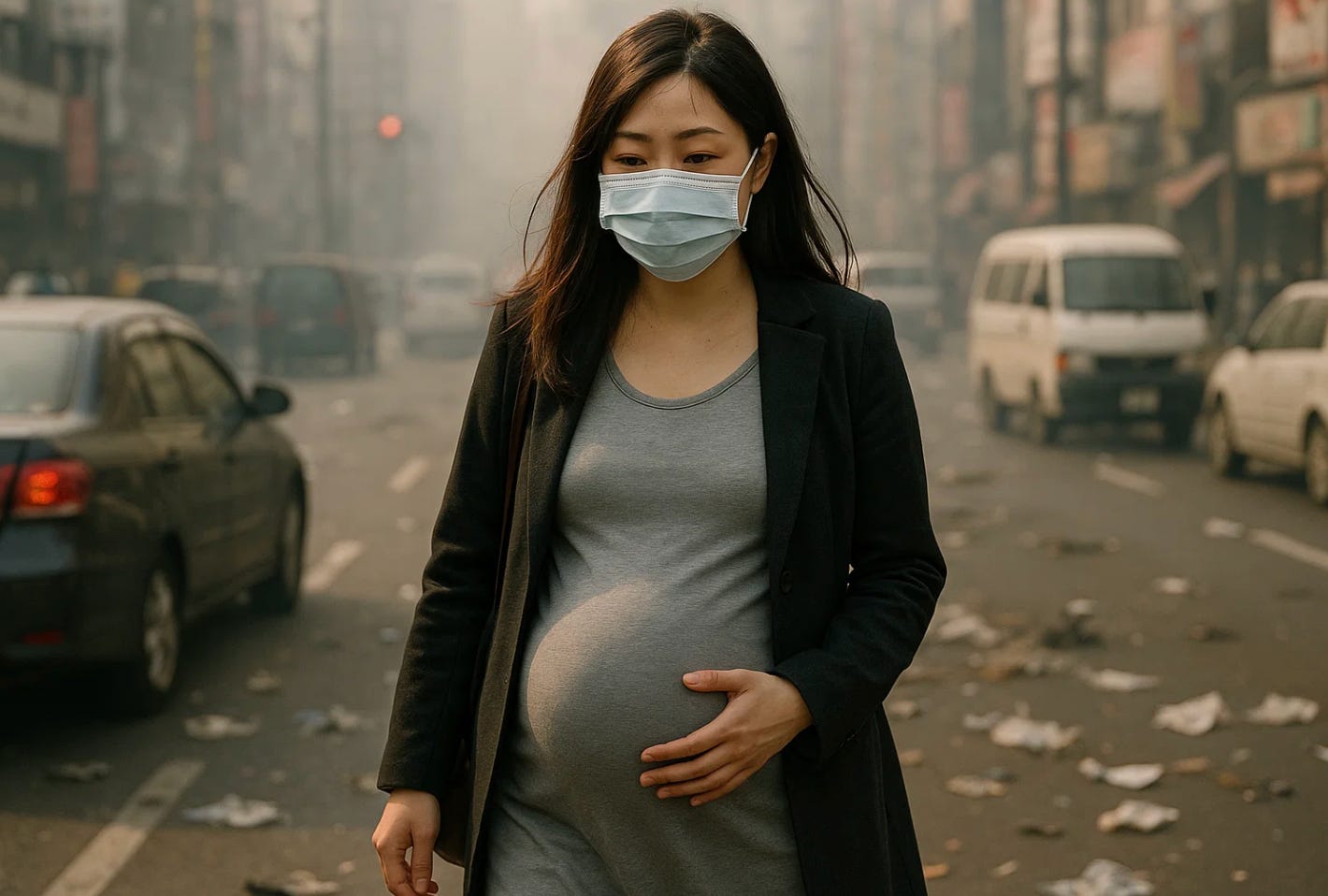
In East Asia, mask-wearing has long been a socially accepted and even expected behavior, not only for infection control but also as protection against air pollution. In countries like Japan, South Korea, and China, masks are used routinely during high-smog seasons or pollen peaks and are viewed as an act of social responsibility and self-care rather than alarm. This cultural normalization of mask use has contributed to lower exposure levels in urban populations and may serve as a model for integrating pollution protection into everyday public health practices worldwide.
Reflection
The Cloutier study reframes air pollution not as an abstract environmental issue but as a reproductive risk factor—a silent, ambient teratogen. While the individual risk increase is small, the societal burden is vast and preventable. For obstetricians, this evidence reinforces the need to incorporate environmental counseling into prenatal care, just as we do for nutrition and infection prevention.
Future medicine will not only treat disease but will defend the conditions for healthy gestation—clean air, safe housing, and equitable access to protection. In that sense, preventing exposure to pollution is not merely an environmental act but an ethical one: safeguarding the developing brain before it ever takes its first breath.