
Birth Plans at a High-Risk Facility (Extended Analysis)
Birth Plan = C-Section": When Clinical Wisdom Becomes Self-Fulfilling Prophecy

A Reddit Post Summary
An L&D nurse on Reddit’s r/nursing at a level 1 trauma center vents about a high-risk induction patient whose birth plan conflicts with medical requirements: continuous monitoring, IV access, pitocin. The patient wanted hydrotherapy, intermittent monitoring, and no IV. OP expresses genuine concern about making it a positive experience despite constraints. The post update reveals a telling attitude: “She got a c-section today. I swear they manifest it upon themselves.”
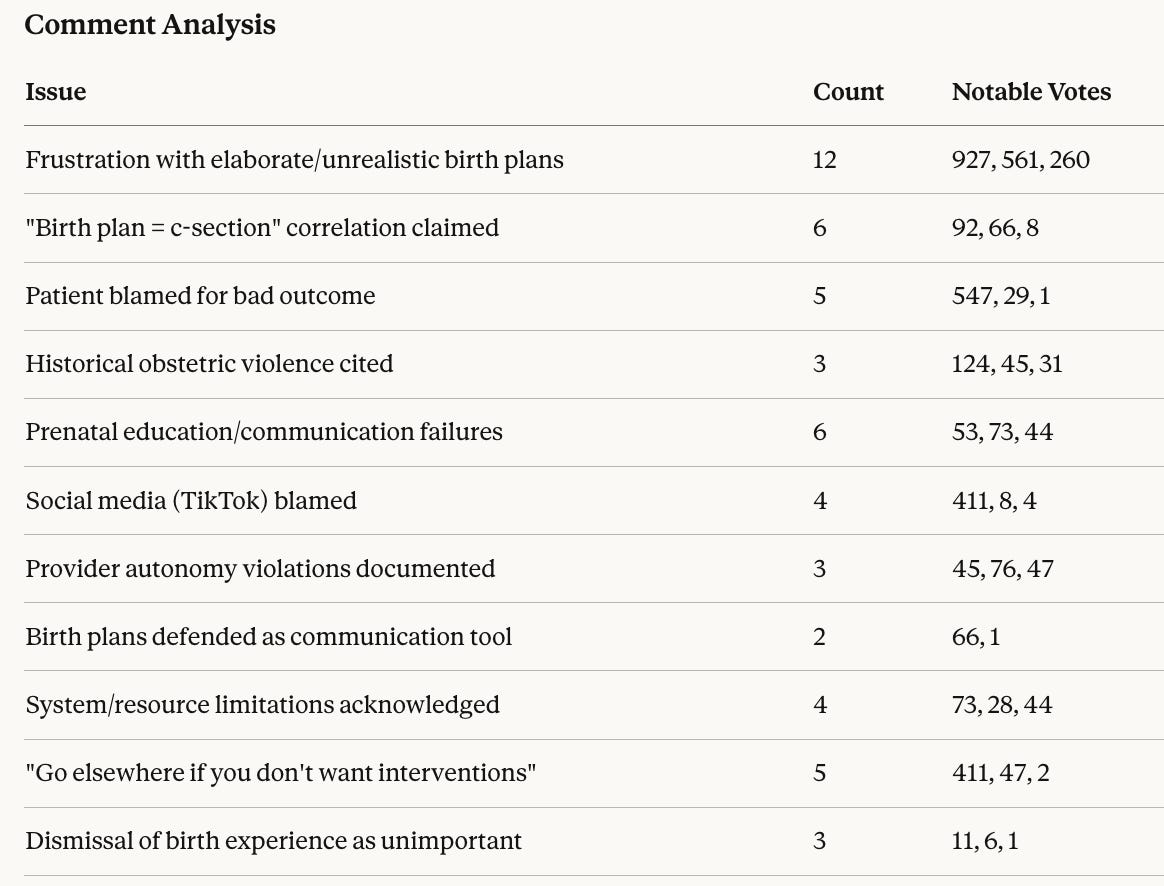
Comment Summary (approximately 60+ visible comments, 150+ collapsed)
The thread reveals deep tensions in L&D culture. The top comment (927 upvotes) describes patients with 20-page birth plans threatening assault charges for IV placement. A reply (547 upvotes) recounts a patient who refused monitoring for 30+ minutes: “when they finally do the baby doesn’t have a heart beat.”
A NICU nurse (321 upvotes) describes parents of 355-gram, 28-week preemies still trying to enforce birth plans, including one mother threatening legal action to breastfeed immediately. NICU staff humor emerges: “your son is on bipap and has decided that breathing is a personal choice.”
Counter-voices appear throughout. One commenter (124 upvotes) shares being given an unwanted episiotomy with a “husband stitch” for a 5-pound baby in the 1980s, causing years of painful sex. A CNM student (53 upvotes) responds directly: “And this is exactly why patients come in with ten page birth plans. Fear. Shame on the providers who don’t provide any education.” Another nurse (lizzzdee, 66 upvotes) offers a minority view: “I love birth plans. They tell me so much about my patient...What are they afraid of? What things are really important to them?”
Multiple NICU nurses repeat the phrase “birth plan = emergency c-section” as clinical wisdom. One nurse suggests patients who want low-intervention births should “go to a birthing center” rather than expect hospitals to accommodate preferences. Several commenters blame “crunchy birth TikTok” for unrealistic expectations.
System failures are acknowledged: nurses don’t see birth plans until admission, sometimes during active labor with decelerations. One commenter notes their facility lacks wireless monitors that would allow shower use during monitoring. A nurse admits physicians “took birth as an opportunity to exert some sort of power/live out their god complex.”
Ethics Comment
This thread is a case study in how institutional cultures develop blind spots. The dominant narrative frames birth plans as pathology predictive of surgical outcomes, rather than as responses to a system that has historically violated patient autonomy.
The “manifestation” claim deserves direct challenge. A patient induced for a high-risk condition who requires cesarean delivery did not cause that outcome through anxiety or preferences. The indication for induction was the cause. Attributing surgical necessity to patient attitude is not clinical reasoning. It’s superstition that conveniently places responsibility on the patient rather than examining whether the intervention cascade itself contributed.
The thread contains its own refutation. A woman describes an unwanted episiotomy with a “husband stitch” causing years of painful sex. A nurse admits some providers “took birth as an opportunity to exert some sort of power/live out their god complex.” Another describes a provider performing a GBS swab without consent: “literally jamming the swab up her rectum and doesn’t even give her the option to say no.” These are not ancient history. They explain why patients arrive defensive.
The workflow reality is important: nurses often don’t see birth plans until patients arrive in labor. This is a systems failure. If birth plans triggered prenatal conversations weeks before delivery, fewer patients would arrive with requests incompatible with their situation. Instead, the system fails upstream, then blames patients at the point of care.
The minority voice (lizzzdee) offers the ethical reframe: birth plans are communication tools that reveal fear, priorities, and opportunities for education. This nurse left her previous job partly because of “abusive providers.” Her perspective acknowledges what the dominant thread culture cannot: that patient defensiveness is often a rational response to documented harm.
What’s absent is any acknowledgment that continuous fetal monitoring in low-risk labor, routine IV placement, and restricted mobility are themselves interventions whose universal application lacks robust evidence. The Cochrane reviews on continuous monitoring versus intermittent auscultation show increased cesarean rates without improved neonatal outcomes in low-risk populations. OP’s patient was high-risk, making monitoring appropriate, but the blanket dismissal of all birth preferences ignores legitimate evidence-based critiques of intervention-heavy American obstetrics.
The statement “The birth is not really about the mother (in most cases) it’s about delivering a healthy baby” reveals the core problem. Maternal experience and maternal safety are not opposed to neonatal outcomes. A system that treats mothers as obstacles to baby delivery rather than patients deserving respect will continue generating the defensive documents it then mocks.
Strong analysis of how institutional biases become self-reinforcing. The workflow failure point is spot on - birth plans reviewed during active labor creates the exact conflicts staff then blame patients for. What stood out is how the thread contains its own counter-evidence with the husband stich example yet the dominat narrative still blames patients. This cognitive dissonance is common in high-stakes environments where acknowledging systemic issues feels threatening.
Once a patient is in opposition to the system of care at the hospital there is an inner emotional and psychological impediment to the normal process of labor. As many midwives know and they support is the inner approach to childbirth. Trauma and fear can interfere with the normal labor process. Many women who have birth plans at hospitals have had little or no preparation for childbirth but are following what they have heard from friends, family, the internet etc