
Artificial Intelligence and Obstetric Practice: An Automation Framework
Applying Nobel Prize-Winning Economic Theory to Understand AI's Transformation of Clinical Medicine

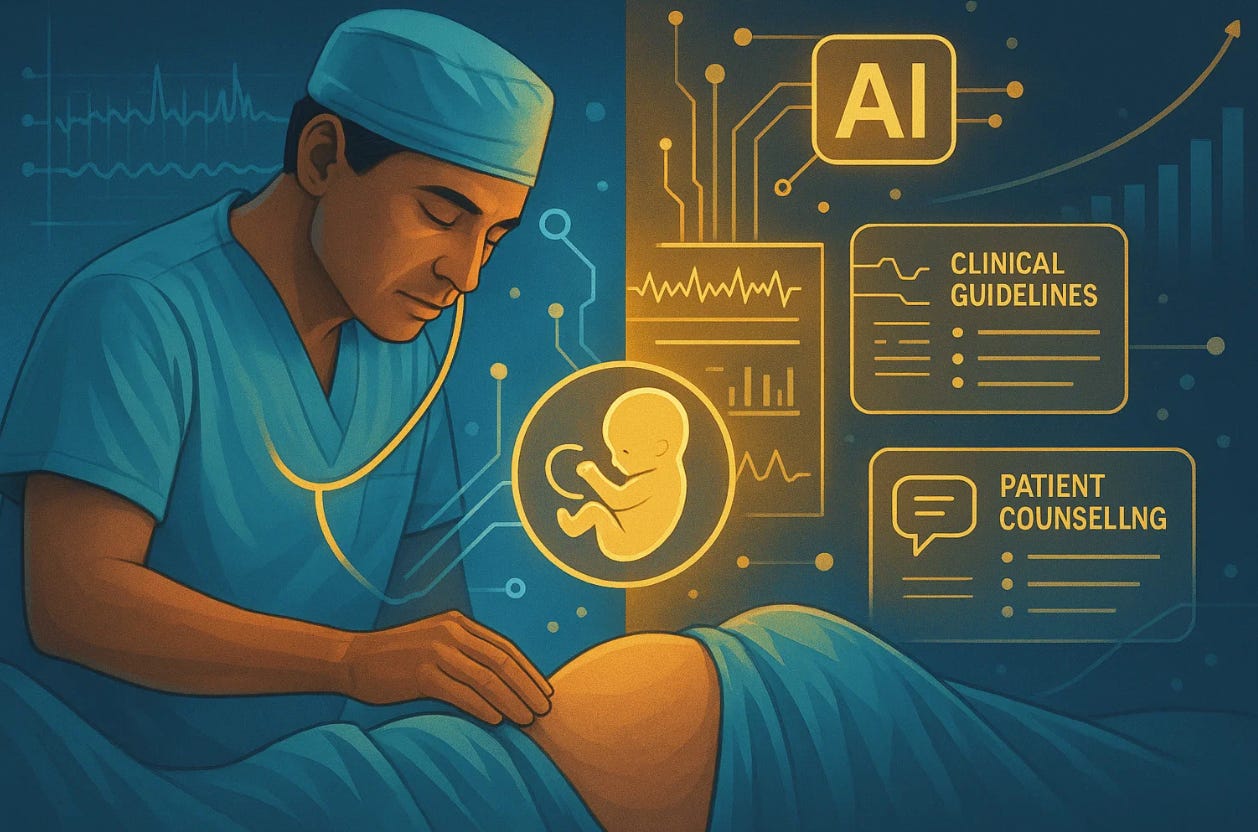
Nobel Prize Winning Economic Growth Theory Meets Clinical Medicine
Philippe Aghion, co-author of the seminal 2017 NBER working paper “Artificial Intelligence and Economic Growth” and recent Nobel laureate in Economics, developed a sophisticated framework for understanding how AI-driven automation affects productivity, labor markets, and economic growth. His work, co-authored with Benjamin F. Jones and Charles I. Jones, models AI as the latest phase in a 200-year process of automation—building on the insights of earlier economists like Joseph Zeira and incorporating William Baumol’s “cost disease” to explain why growth may be constrained not by what we automate successfully but by what remains essential yet difficult to improve.
While Aghion’s framework was developed to understand macroeconomic dynamics, its insights apply powerfully to understanding transformation within specific professions—particularly medicine. A critical observation from recent experience is that Generative AI (GAI) demonstrates superiority not merely in narrow technical tasks but increasingly in the daily cognitive work that comprises most professional activity: synthesizing information, generating written content, providing explanations, and offering guidance. This suggests automation may proceed faster in knowledge work than in specialized technical domains, inverting traditional assumptions about which jobs face displacement risk.
Applying this economic framework to obstetrics reveals how AI-driven automation is reshaping clinical practice in ways that parallel broader economic transformations, with profound implications for how obstetricians train, practice, and deliver care.
The Automation of Obstetric Tasks
Artificial intelligence in obstetrics can be understood as the latest form of clinical automation—a process dating back to the introduction of electronic fetal monitoring, ultrasound technology, and computerized laboratory systems. Just as electricity and semiconductors facilitated automation in the last century, AI now seems poised to automate many obstetric tasks once thought to require human judgment, from interpreting fetal heart rate tracings to predicting preterm birth risk and optimizing cesarean delivery timing. How will this affect clinical practice, the division of labor between physicians and technology, and the quality of obstetric care?
A Task-Based Framework for Obstetric Care
Following the automation models in economics, we can conceptualize obstetric practice as comprising numerous discrete tasks. Traditional assumptions held that clinical counseling would resist automation, remaining a fundamentally human domain. However, emerging evidence suggests AI-assisted counseling may be superior to human-only approaches. AI counseling systems can provide more comprehensive information by instantly accessing the entire medical literature, offer more consistent guidance without cognitive biases or fatigue, remain available continuously, and personalize recommendations by processing vast datasets of similar patient outcomes—capabilities no individual physician can match.
Importantly, GAI’s superiority emerges most clearly in these routine daily tasks—explaining test results, discussing treatment options, addressing common concerns—rather than in rare, highly specialized scenarios. This pattern mirrors findings across other professions where GAI excels at the “bread and butter” work that comprises 80% of professional time.
Reconsidering the Limits of Automation
This superior performance of AI extends beyond direct patient counseling to include the creation of clinical guidelines and patient educational materials—tasks traditionally performed by expert committees and medical writers. AI can synthesize evidence from thousands of studies instantaneously, identify conflicting recommendations across guidelines, detect gaps in evidence, and generate patient information materials at appropriate literacy levels in multiple languages simultaneously. A human guideline committee might take two years to review the literature and reach consensus; AI can incorporate new evidence within hours of publication and update recommendations in real-time.
Similarly, AI-generated patient information can be dynamically personalized—adjusting explanations based on a patient’s specific risk factors, cultural background, health literacy level, and expressed concerns—far exceeding the one-size-fits-all handouts human writers produce. This challenges the assumption that high-level cognitive synthesis remains a uniquely human capability.
Transforming Academic Knowledge Production
Perhaps even more transformative is AI’s potential to revolutionize the peer review process—a critical bottleneck in medical knowledge dissemination. Traditional peer review in obstetrics can take 6-18 months from submission to publication, with reviewers working pro bono, often introducing unconscious biases related to author institutions, geography, or adherence to established paradigms. AI can assess manuscripts within days, evaluating methodological rigor against established standards, identifying statistical errors, detecting plagiarism or data fabrication, checking citation accuracy, and flagging potential conflicts with existing literature—all without the cognitive biases, personal rivalries, or fatigue that affect human reviewers.
Moreover, AI peer review can be more consistent and comprehensive than human review, which varies dramatically based on reviewer expertise, availability, and diligence. By removing institutional bias, AI may accelerate knowledge diffusion from resource-limited settings where important obstetric research often originates but faces publication barriers. This could compress the timeline from discovery to clinical implementation from years to months, fundamentally accelerating the rate at which obstetric practice improves.
This represents another daily cognitive task—critical appraisal of research—where AI demonstrates clear superiority over human performance, further supporting the broader thesis that GAI excels at routine intellectual work.
The Scope of Cognitive Automation
If AI excels at synthesizing complex information, calculating personalized risks, creating evidence-based guidelines, presenting options in culturally sensitive educational materials, and conducting rigorous peer review, what remains uniquely human? Perhaps only the most irreducible elements: the physical examination, procedural interventions, and serving as a trusted advocate when patients face institutional systems. Even shared decision-making—long considered the pinnacle of patient-centered care—may be enhanced when AI provides more thorough, unbiased counseling than time-pressured physicians can deliver.
This creates an interesting paradox. As AI demonstrates superiority in clinical counseling, guideline creation, and academic peer review—traditionally considered “high-skill” cognitive tasks—we may see faster automation of intellectual work than procedural skills. The obstetrician’s comparative advantage shifts toward tasks requiring manual dexterity, real-time crisis management, and physical presence during delivery.
Implications for Practice Organization and Professional Identity
The introduction of superior AI counseling, guideline generation, and accelerated peer review into obstetric practice creates profound organizational changes. Traditional hierarchies based on knowledge accumulation may flatten as AI democratizes access to expert-level reasoning. The distinction between generalists and specialists may blur when any clinician can access subspecialty-level AI guidance instantaneously. Academic prestige may shift from those who write the most papers to those who design the most effective AI validation systems.
Practices may restructure around AI-delivered counseling and real-time guideline implementation, with physicians focusing on interpretation of AI recommendations, procedural interventions, and managing cases where AI reaches equipoise between options. Professional societies may transform from guideline-writing bodies to AI-validation organizations, ensuring algorithms incorporate appropriate values and address health equity concerns. Medical journals may evolve from gatekeepers of knowledge to curators of AI-vetted research, focusing on interpretation and clinical implementation rather than primary quality assessment. This represents a fundamental shift in professional identity—from primary information provider to proceduralist and AI interpreter.
Paradoxically, this may increase the value of human judgment in specific domains. When AI counseling is comprehensive and evidence-based, the physician’s role becomes helping patients navigate decisions when the evidence is unclear, conflicting, or doesn’t account for unmeasurable patient values. These “frontier” decisions—where even optimal AI reaches its limits—may command higher premiums, even as routine counseling and guideline application are automated.
Furthermore, superior AI performance in knowledge synthesis and peer review may dramatically reduce practice variation and accelerate knowledge diffusion across obstetric care. Geographic disparities in access to current guidelines could diminish as any provider anywhere implements real-time, evidence-based recommendations. The publication lag that perpetuates outdated practices could shrink from years to weeks. However, this might also exacerbate creative destruction in medicine: as AI rapidly incorporates new evidence into guidelines, counseling, and validated research, the half-life of physician knowledge shortens, potentially discouraging human investment in traditional continuing education.
Looking Forward: The Future of Obstetric Expertise
Following Aghion’s insight about Baumol’s cost disease, the future of obstetric care may be constrained not by what AI does brilliantly but by what remains essential yet resistant to improvement. The challenge for obstetrics is determining which human skills remain truly essential as AI demonstrates superiority across an expanding range of daily clinical and intellectual tasks—from patient counseling to guideline creation to peer review. The answer may lie not in what physicians know, but in how they serve as trusted advisors helping patients navigate complex decisions, skilled proceduralists managing clinical emergencies, and ethical guardians ensuring AI systems serve patients’ best interests rather than institutional efficiency. The future of obstetric expertise may depend less on information mastery and more on wisdom, judgment, and the irreducible human elements of healing.