
AI-Powered Preterm Birth Prediction: Are We Ready to Act on It?
Algorithms can identify high-risk patients earlier. We still don’t have treatments that work.

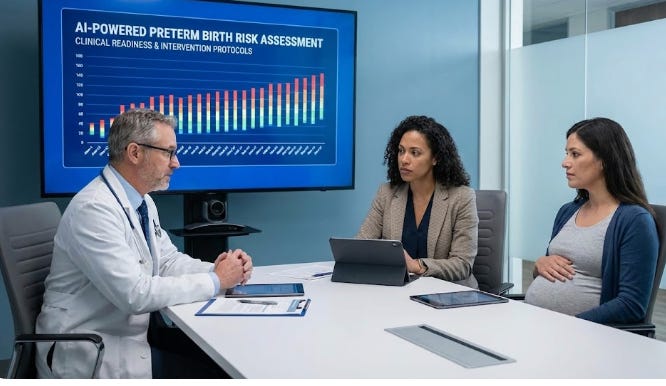
A blood test at 19 weeks tells you a patient has a 25% chance of delivering before 37 weeks.
What do you do?
If you’re honest, the answer is: not much that’s proven to help.
This is the uncomfortable truth about the new generation of preterm birth prediction tools. The algorithms are increasingly sophisticated. The science is real. The marketing is compelling. But the fundamental problem remains unsolved: prediction without effective prevention is just earlier anxiety.
Are you at risk for preterm birth? Check our Preterm Birth Prevention Tool
The Promise
Preterm birth affects more than 1 in 10 babies in the United States. It’s the leading cause of infant death and long-term disability. For decades, we’ve been able to identify two groups at elevated risk: women with a prior preterm birth and women with a short cervix on ultrasound.
The problem? These two factors together miss about 80% of spontaneous preterm births. Most babies born too early come from mothers we never flagged as high risk.
Enter the biomarker revolution.
Sera Prognostics developed PreTRM, a blood test measuring two proteins (IBP4 and SHBG) between 18 and 20 weeks. The company claims it identifies pregnancies at elevated risk even when traditional risk factors are absent. Other companies are developing competing proteomic and metabolomic approaches. Machine learning models trained on electronic health records promise even broader prediction.
The recently published PRIME trial enrolled over 5,000 women and reported a 20% reduction in NICU admissions when high-risk patients (identified by PreTRM) received a bundle of interventions.
Sounds promising. So what’s the problem?
The Problem
