
A True Milestone Reached: 500 Subscribers
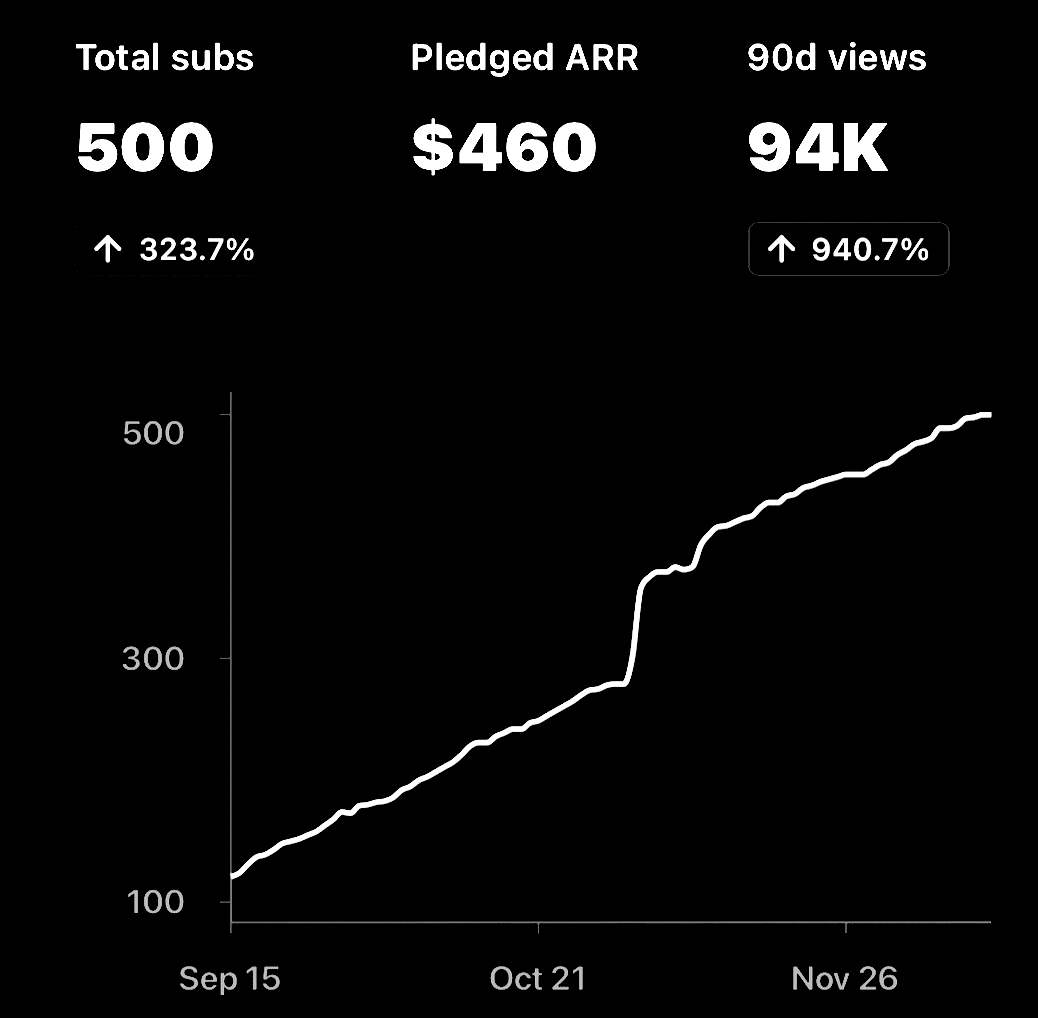
Subscriber growth during last 3 months exceeds 300%, and readership has increased nearly tenfold. We are in the 95th Percentile of active Substack newsletters by early momentum.

I want to share a brief update on this newsletter—not only in terms of numbers, but in terms of how and why this work is being done.
We recently crossed 500 subscribers, with 94,000 views over the past 90 days. Subscriber growth during this period exceeds 300%, and readership has increased nearly tenfold. In context, that trajectory is unusual.
Fewer than 5% of newsletters ever reach 500 subscribers here, and reaching this level in under three months of concentrated growth places this publication roughly in the top 95th percentile of active Substack newsletters by early momentum. These figures don’t imply scale—but they do suggest signal.
The signal matters because the subject matter here—pregnancy, obstetrics, and reproductive science—is complex, emotionally charged, and often poorly communicated. Obstetrics is one of the most universal human experiences, yet much of its practice remains tradition-driven, opaque, or inconsistently grounded in evidence. Patients are frequently asked to comply without context, while clinicians navigate uncertainty, liability, and guidelines that lag behind emerging science.
My approach to this work is shaped by long experience with scientific rigor. Over the past five to six years, I have completed more than 100 peer reviewed publications in respected medical journals, a level of publications that places me among the top ~1% of obstetricians worldwide in publication activity.

Among my many favorites are “Defining Fever”, “Why Do Women Choose Home Births”, Physician hesitancy to recommend COVID‐19 vaccination in pregnancy as a cause of maternal deaths. We were the first obstetricians in the world to recognize and publish a paper on ChatGPT: “The exciting potential for ChatGPT in obstetrics and gynecology”.
Writing and publishing a peer reviewed publication is not a casual task. It is often a months-long process involving repeated drafts, detailed methodological critique, statistical scrutiny, navigating politicis and language, and difficult editorial decisions. It is slow by design, and intentionally demanding, because it protects the integrity of the scientific record.
That process has deeply influenced how I read evidence, assess risk, and communicate uncertainty. But it also has limits. Academic publishing is necessarily constrained by format, tone, and time. Important insights can take years to appear in print, and even then, they are rarely written in a voice accessible to patients or clinicians outside a narrow subspecialty.
This is where Substack has been transformative. It allows me to write with the same respect for evidence, but with greater speed, clarity, and honesty. It allows nuance without jargon, explanation without condescension, and uncertainty without false reassurance. Most importantly, it allows me to speak in my own voice.
This newsletter exists to build what I think of as obstetrical intelligence: a way of thinking about pregnancy that integrates physiology, probability, and scientific humility. That means asking where recommendations come from, how risk is framed (and often distorted), and where evidence genuinely ends.
In the months ahead, I’ll be continuing to write regular newsletters, expanding coverage of pregnancy physiology, labor mechanics, ethics, guideline formation, decision-making under uncertainty, and emerging research in maternal-fetal medicine. And, yes, sometimes criticism of the medical establishment which to me is too stagnant.
The numbers are not the goal—but they are signals. And right now, the signal is clear: there is a strong appetite for careful, evidence-based, human-centered thinking about pregnancy.
I’m grateful you’re here—and grateful to Substack for making this kind of work possible