
A Birth in a Stable: What the Nativity Teaches About Safety
The story of December 24 invites us to look honestly at childbirth without clinicians, without hygiene, and without the protections modern women deserve.

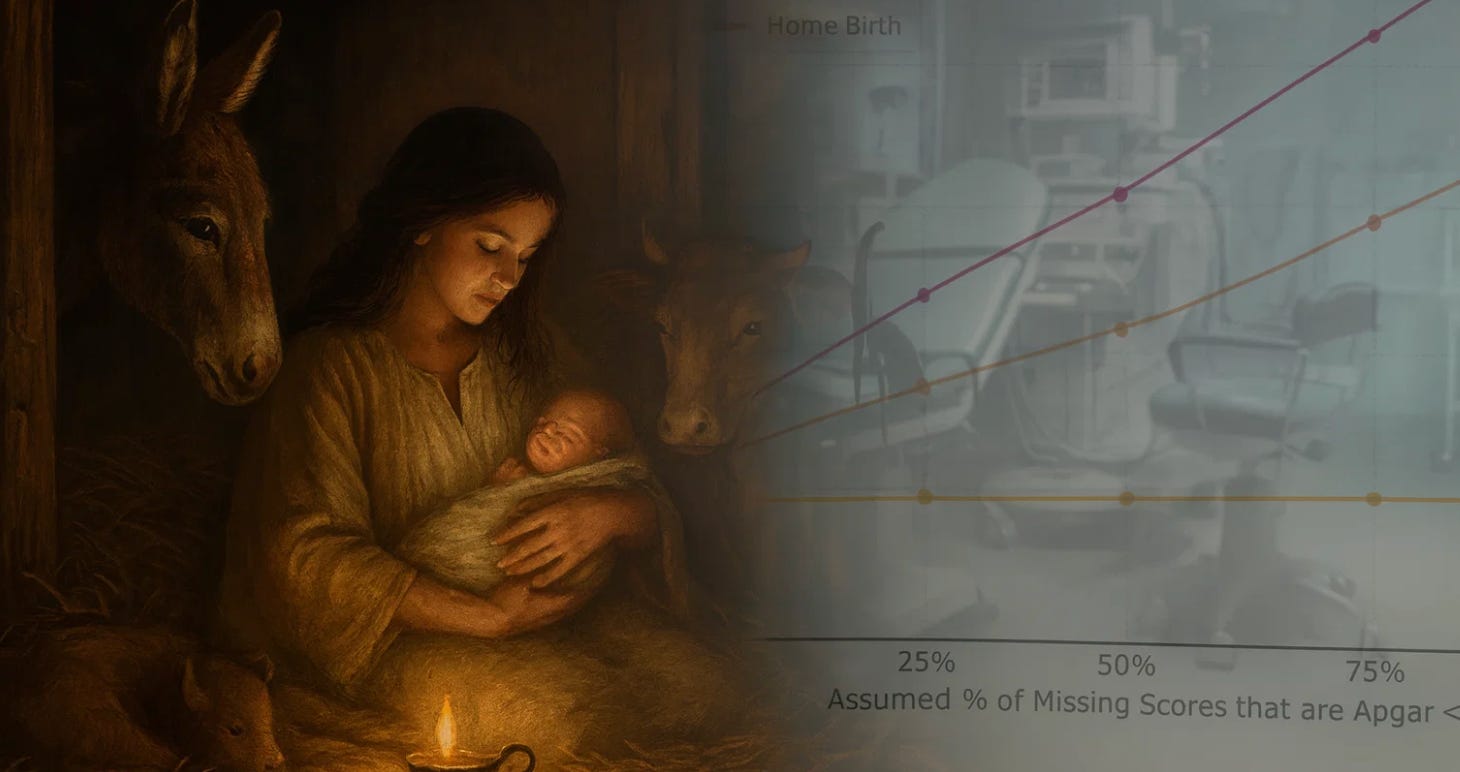
Childbirth imagery on December 24 is warm and familiar. A stable. A manger. Animals nearby. A young woman laboring without medication, without sterile instruments, and without a trained attendant. For many people this scene carries deep spiritual meaning. For clinicians it also reveals something else, something more difficult. It illustrates the reality of childbirth before obstetrics existed. It shows what birth looked like when most women delivered at home or outdoors or in shelters, and when maternal and infant mortality were staggeringly high.
The historical details are sparse, but the context is clear. In the first century, childbirth was dangerous. Survival depended on luck, local customs, and the presence of experienced women in the community. There were no antibiotics, no ways to control postpartum hemorrhage, no operative techniques to rescue obstructed labor, no concept of sepsis prevention, and no neonatal intensive care. A woman who labored in a stable surrounded by animals was exposed to contaminated surfaces, animal waste, and airborne pathogens. These were the very conditions that repeatedly killed women through infection long before Semmelweis demonstrated the life saving power of handwashing.
Modern discussions of “natural birth” sometimes romanticize unassisted delivery, but historically a birth unattended by a trained midwife or knowledgeable helper was not a symbol of empowerment. It was a marker of isolation and danger.
Today we would call it a “freebirth,” meaning a planned delivery without any licensed professional present. Our published research on birth settings has highlighted that environments lacking skilled supervision carry higher risks of adverse outcomes for both mother and baby. Freebirth, particularly in locations with poor sanitation, remains one of the riskiest choices a pregnant woman can make. The Nativity story places Mary directly in such a scenario. No midwife. No sterile field. No pain relief. No ability to manage hemorrhage or obstructed labor. It is a testament to survival rather than a model for obstetric care.
The absence of pain management often receives attention. Mary, like all women of her time, had no access to what we take for granted today. No epidural. No intravenous narcotics. No nitrous oxide. Pain was endured, not treated. Yet the larger issue is not the lack of analgesia, but the lack of safety systems. Modern obstetrics has been built on the principle that birth should preserve the health of both mother and baby. It requires clean facilities, trained personnel, respectful care, and the ability to intervene when needed. Delivery on the floor of a stable meets none of these criteria.
We must also acknowledge how quickly infection could kill newborns in those centuries. Neonatal tetanus, sepsis from unclean instruments or surfaces, and respiratory infections were common.
The newborn in this story is laid in a feeding trough, a reminder of how fragile early life was and how extraordinary survival could be in such conditions. It is also a reminder that biology is indifferent to sacred narrative. A newborn placed among animals is at risk. Modern obstetrics cannot accept preventable risks simply because they are wrapped in tradition or imagery.
Our published work on out of hospital births, including discussions on home birth safety, has consistently shown that outcomes worsen when predictability decreases and when access to emergency care is limited.
Some settings can be safe if the woman is low risk, the midwife is well trained, and transfer systems are robust. But freebirth does not meet these criteria. It is unmanaged, unsupervised, and unprotected. The Nativity scene corresponds far more to the latter than the former.
The story also transitions eight days forward. In Jewish tradition, the eighth day marks circumcision, a ritual commandment described in the Torah.
January 1 is still recognized in some Christian calendars as the Feast of the Circumcision of Christ, a reminder that this moment was part of the early life of a Jewish male newborn.
Historically, the procedure was performed with simple instruments in community settings. It carried risks of bleeding and infection, yet it also reflected a profound cultural and religious identity. In the ancient world, circumcision signified belonging, covenant, and continuity. It is worth remembering that in modern medicine circumcision is performed in controlled environments with sterile technique, analgesia, and screening for bleeding disorders. The contrast is stark. The eighth day in antiquity was both sacred and medically precarious. The eighth day today is safer because hygiene, technique, and neonatal assessment are far more advanced.
January 1 therefore represents an intersection of cultural meaning and medical vulnerability. It underscores how traditions persist even as science evolves. For Jewish families, the eighth day remains significant. For clinicians, it is another point on the timeline reminding us that newborns require careful attention, that procedures must be safe, and that cultural practices and medical realities must coexist responsibly.
This moment in the story of Jesus is powerful not because it shows ideal clinical practice, but because it reveals how far we have come.
Maternal mortality in the first century was high. Infant mortality was high. Many women did not survive childbirth, and many newborns did not survive the first month of life.
The Nativity story is therefore not a template for modern obstetric behavior. It is an origin story surrounded by risk, in a world without the protections we now consider basic. It should make us grateful for the progress made, and honest about the dangers that persist whenever childbirth takes place outside safe systems.
Modern obstetrics must continue to insist on safety, cleanliness, trained attendants, and evidence based practices. The symbolism of a birth in a stable can inspire reflection, but it should never lead us to minimize the risks of unsupervised birth today. Mary survived. Jesus survived. Countless others in similar conditions did not. That is the real historical backdrop of this season.
Closing Reflection
The Nativity is a story of survival against the odds. The lesson for clinicians is simple. Safety is not a luxury. It is the foundation of childbirth. When we drift toward nostalgia for unassisted birth, we forget the women and infants who never lived to see their own eighth day.